
Protecting the Fee Stream
A Forensic Deconstruction of Julius Baer's Case Against Bitcoin

Why This Was Written
In February 2026, Julius Baer Group CIO Yves Bonzon published a widely circulated piece arguing that Bitcoin should no longer be considered digital gold. Within hours, a member of the Julius Baer marketing team was pushing it across LinkedIn. By the following morning, it had been shared by several senior staff. This is not organic intellectual curiosity; it is institutional narrative distribution.
I commented on the original post raising a simple question: does the staff see themselves as having a mission to debunk Bitcoin, or does the analysis just happen to align conveniently with a business model that needs clients in assets the bank can custody, manage, and charge fees on? The question was genuine. The silence was telling.
This report exists because institutional investors deserve better than selectively applied logic dressed up as fiduciary caution. Bonzon’s piece contains valid observations; the leverage point is real, the quantum risk deserves attention. But, his conclusions do not follow from his evidence. He confuses a cyclical liquidity event with structural failure, treats a living protocol as static code, and applies the quantum threat exclusively to the one asset that competes with his fee structure while ignoring that the same cryptography underpins the entire digital financial system his bank operates within.
The Rogue Protocol exists to do what internal compliance departments and sell-side research desks cannot: tell institutional readers what the data actually shows, even when it contradicts the house view. This is that document.
Bonzon’s piece can be read here
One point of principle before you read further. This report is not written from a pro-Bitcoin or pro-gold position. The Rogue Protocol has no allocation to defend and no narrative to protect. We have been equally critical of maximalist rhetoric that ignores inconvenient data, and this report explicitly corrects several claims circulating in pro-Bitcoin circles that are empirically unsupported, including the widely repeated assertion that BTC-Gold correlation reached 0.85. It did not. The only position we hold is that institutional readers are entitled to analysis built on what the data shows, not what any party, bull or bear, bank or blogger wishes it showed.
Agnostic forensics is the only methodology that survives contact with reality.
Executive Summary
In February 2026, Julius Baer published “Revisiting the hypothesis of digital gold” by Group CIO Yves Bonzon. The article argues that Bitcoin should no longer be considered digital gold, citing (1) 2025 performance divergence with gold, (2) leverage-driven retail behaviour, and (3) the emerging quantum computing threat. The piece concludes that Bitcoin no longer belongs in the category of out-of-system assets.
This report subjects each pillar of that argument to forensic scrutiny across three dimensions: logical consistency, empirical evidence, and alternative explanations the original article ignores.
Core Finding: Bonzon commits a fundamental attribution error by conflating a cyclical, liquidity-driven deleveraging event with a structural degradation of Bitcoin’s value proposition. His quantum argument, while directionally valid as a long-term risk factor, ignores active protocol development and mischaracterises the threat timeline. His conclusion appears shaped more by fiduciary convenience than forensic rigour.
Critical Disclosure: This report also corrects several claims circulating in pro-Bitcoin rebuttals that are empirically unsupported. The BTC-Gold correlation has not reached >0.85. According to CME Group data (February 2026), Bitcoin’s correlation with gold has weakened to approximately zero, while its correlation with the Nasdaq 100 sits at +0.35 to +0.60. Intellectual honesty requires us to work with the data as it exists, not as we wish it to be.
Part 1: The Performance Narrative
What Bonzon Claims
Gold rose +66% in 2025. Bitcoin fell -6.3%. Ergo, Bitcoin is not digital gold. This framing is superficially compelling but analytically myopic.
What the Data Actually Shows
The Timeframe Problem
Bonzon cherry-picks a single calendar year. Bitcoin’s all-time high of $126,080 was reached in early October 2025. The subsequent drawdown to approximately $80,553 by late November, and further to $60,033 in early February 2026, represents a 47% peak-to-trough correction. This is severe, but it is not unprecedented in Bitcoin’s history, nor is it evidence of a structural failure.
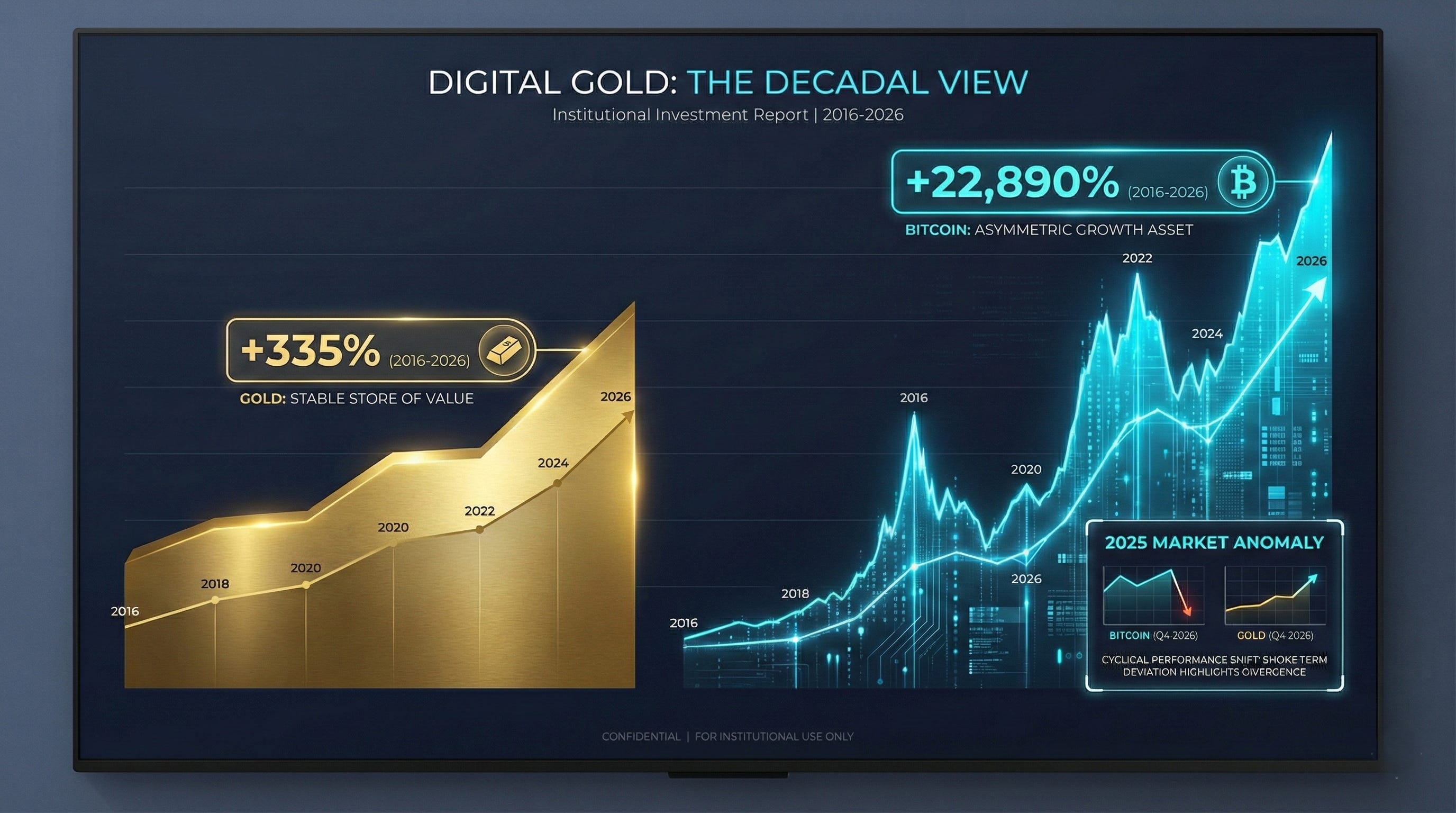
The 10-year comparison tells a different story: Bitcoin has returned approximately 22,890% versus gold’s 335%. Single-year performance divergences between asset classes are routine. Gold itself underperformed equities for much of 2013-2022. No serious analyst used that underperformance to declare gold structurally broken.
The Correlation Reality
Here is where intellectual honesty forces a difficult admission. Bitcoin’s correlation with gold has collapsed to approximately zero in 2025-2026. CME Group data shows that Bitcoin currently exhibits its strongest correlation with the Nasdaq 100 (+0.35 to +0.60), not with gold. This is not evidence that the digital gold thesis is permanently dead, but it is evidence that the thesis is currently dormant. The market is treating Bitcoin as a high-beta risk asset, not a store of value. Bonzon is directionally correct on this point for the current regime.
But Regime-Dependence Is Not Structural Failure
CryptoSlate’s February 2026 analysis identifies three distinct Bitcoin identity regimes: hedge/store-of-value, high-beta tech, and liquidity sponge. The current regime favours the tech identity. But correlation regimes rotate. From November 2022 to November 2024, gold and Bitcoin moved in tight correlation, with gold gaining 67% while Bitcoin surged nearly 400%. The relationship frayed when the macro regime shifted. Declaring the thesis dead based on one regime is equivalent to declaring gold a poor inflation hedge because it underperformed during the 2013-2019 disinflationary period.
Part 2: The Leverage Argument
What Bonzon Claims
Bitcoin investors use excessive leverage, causing it to behave like a high-beta IT stock during margin calls. Gold investors do not use much leverage. This creates divergent behaviour during stress events.
What Bonzon Gets Right
This is his strongest point. The Q4 2025 correction was demonstrably driven by deleveraging. BlackRock’s iShares Bitcoin Trust (IBIT) experienced $2.7 billion in redemptions over five consecutive weeks from late October through November. Total spot Bitcoin ETF outflows for November-December reached $4.57 billion, the worst two-month stretch since their January 2024 launch. CryptoQuant data confirmed that monthly whale inflows halved from approximately $7.88 billion to $3.86 billion in December.
The Logical Error: Structure vs. Symptom
Bonzon correctly diagnoses the symptom but misidentifies it as a structural defect. Leverage is a market structure phenomenon, not an intrinsic property of the underlying asset. Gold markets also employ leverage (futures, options, CFDs), but the investor base composition differs. Bitcoin’s leverage profile reflects its stage of market maturation and its investor demographics, not a fundamental flaw in its monetary properties.
The critical distinction: Bitcoin’s scarcity (21 million hard cap), its lack of counterparty risk in self-custody, and its resistance to seizure are intrinsic properties of the protocol. Leverage is a behaviour of market participants interacting with the asset. Conflating the two is analytically sloppy.
Moreover, the $4.57 billion in ETF outflows occurred within a year where crypto ETFs attracted $34-47 billion in net inflows globally. IBIT alone took in $25.1 billion for the year. Framing the year-end correction as a structural repudiation ignores the overwhelming net positive flow picture. As CoinShares noted, the November outflow of $1.94 billion represented a reversion after sustained accumulation, not a regime change.
Part 3: The Quantum Computing Argument
What Bonzon Claims
Quantum computing casts doubt on Bitcoin’s security. Quantum computers could enable the theft of over 6 million bitcoins. This tail risk is approaching more rapidly than expected. Bitcoin’s store of value premise is severely challenged. Debate over burning vulnerable coins would constitute expropriation, further undermining Bitcoin’s core tenets. Bitcoin should no longer be considered a digital equivalent of gold.
The Vulnerability Is Real but Radically Overstated
The Numbers in Context
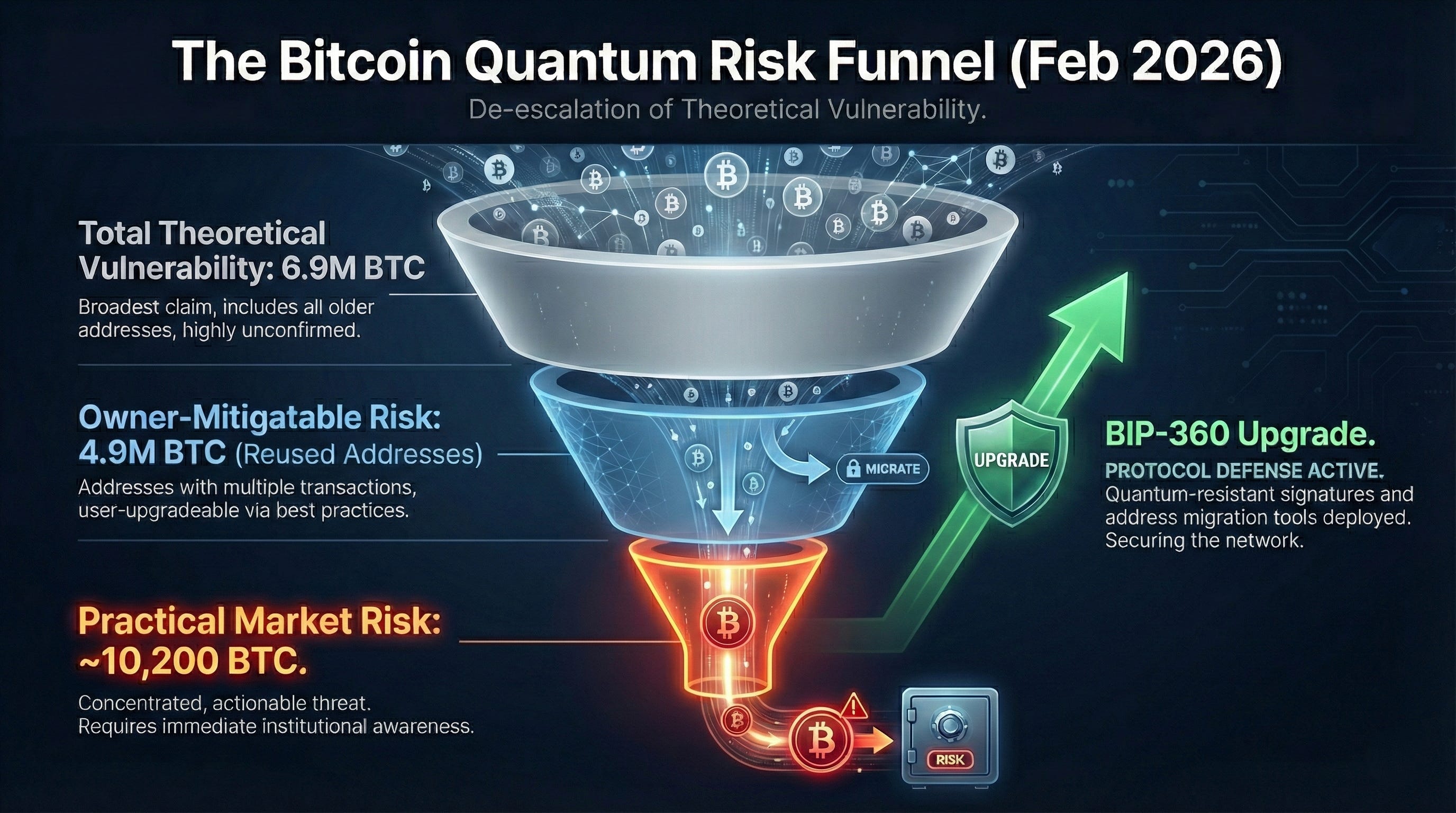
Bonzon’s claim of “over 6 million bitcoins” at risk requires granular examination. Human Rights Foundation research and Deloitte analysis identify approximately 6.51-6.9 million BTC with exposed public keys. However, this headline figure obscures critical nuance:
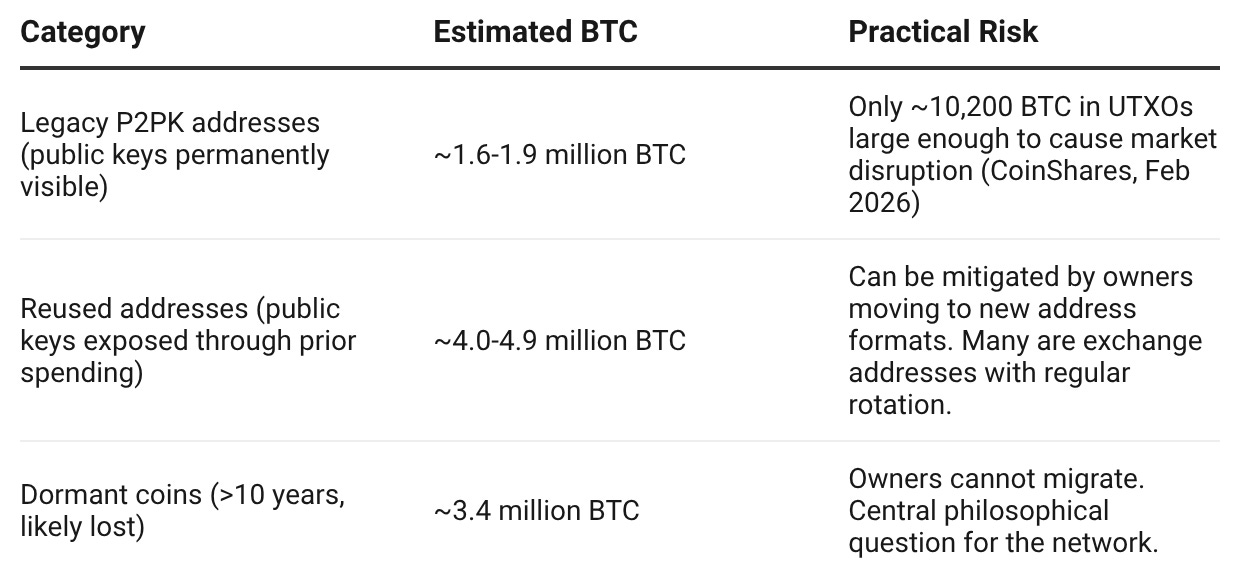
CoinShares’ February 2026 analysis is particularly important: they estimate that only approximately 10,200 BTC sits in UTXOs concentrated enough that their theft could cause appreciable market disruption. The remaining 1.6 million P2PK coins are distributed across 32,607 individual UTXOs averaging ~50 BTC each. A quantum attacker would need to crack these one by one, a process that would take extraordinarily long even under optimistic quantum development scenarios.
The Timeline Mismatch
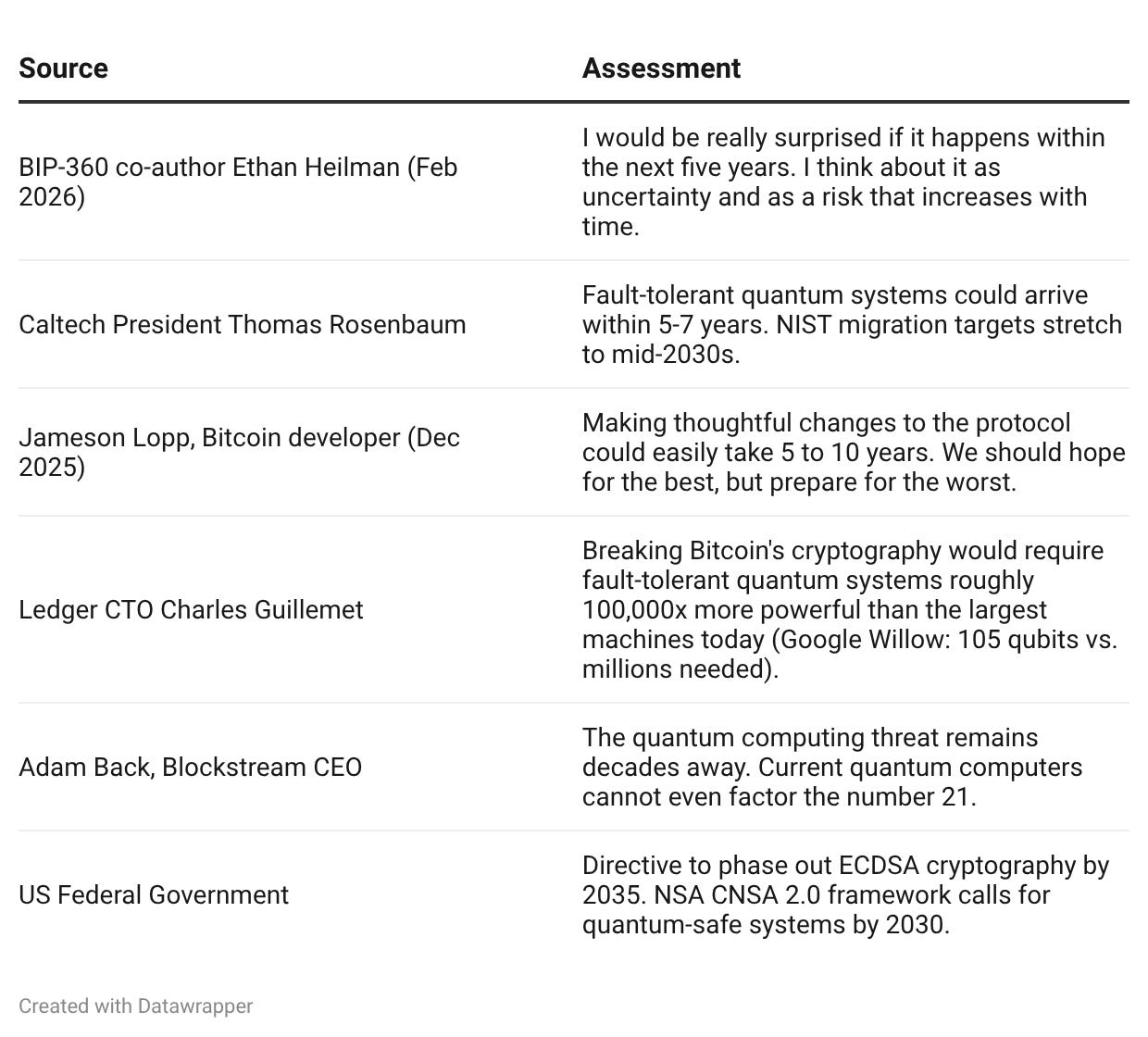
Bonzon states the threat is approaching more rapidly than expected, yet admits it remains a tail risk. These positions are contradictory for a long-duration asset thesis. The actual expert consensus:
The Static Protocol Fallacy
Bonzon’s most egregious analytical error is treating Bitcoin as a static piece of code incapable of adaptation. In reality, Bitcoin’s protocol upgrade mechanism is actively addressing the quantum threat:
BIP-360 was merged into the official Bitcoin GitHub repository in February 2026. This proposal introduces Pay-to-Merkle-Root (P2MR), a new output type that removes the quantum-vulnerable key-path spending from Taproot while preserving upgrade capability. It uses NIST-standardised post-quantum algorithms including ML-DSA (Dilithium) and SLH-DSA (SPHINCS+). This is not theoretical. It is in formal review. Charles Edwards of Capriole Investments advocates for 2026 implementation with compliance penalties by 2028.
The US government itself recognises this is a managed transition, not an extinction event, setting ECDSA phase-out deadlines for 2035 and quantum-safe infrastructure targets for 2030. If the world’s most security-conscious institutions consider this manageable, it is difficult to argue that it represents an immediate disqualification of Bitcoin’s store-of-value properties.
The Burn/Confiscation Dilemma: A Sign of Governance, Not Failure
Bonzon cites the debate over burning vulnerable coins as evidence of Bitcoin’s instability. The forensic read is precisely opposite. The existence of this debate demonstrates a decentralised governance process actively confronting a known risk. The community is debating the most ethical way to handle the transition, balancing property rights against network security. This is proactive risk management, not existential crisis.
Part 4: The Out-of-System Asset Thesis
Why Gold Is Winning: Central Bank Structural Demand
Bonzon correctly identifies that gold’s ascent is underpinned by structural central bank demand. The data is overwhelming:
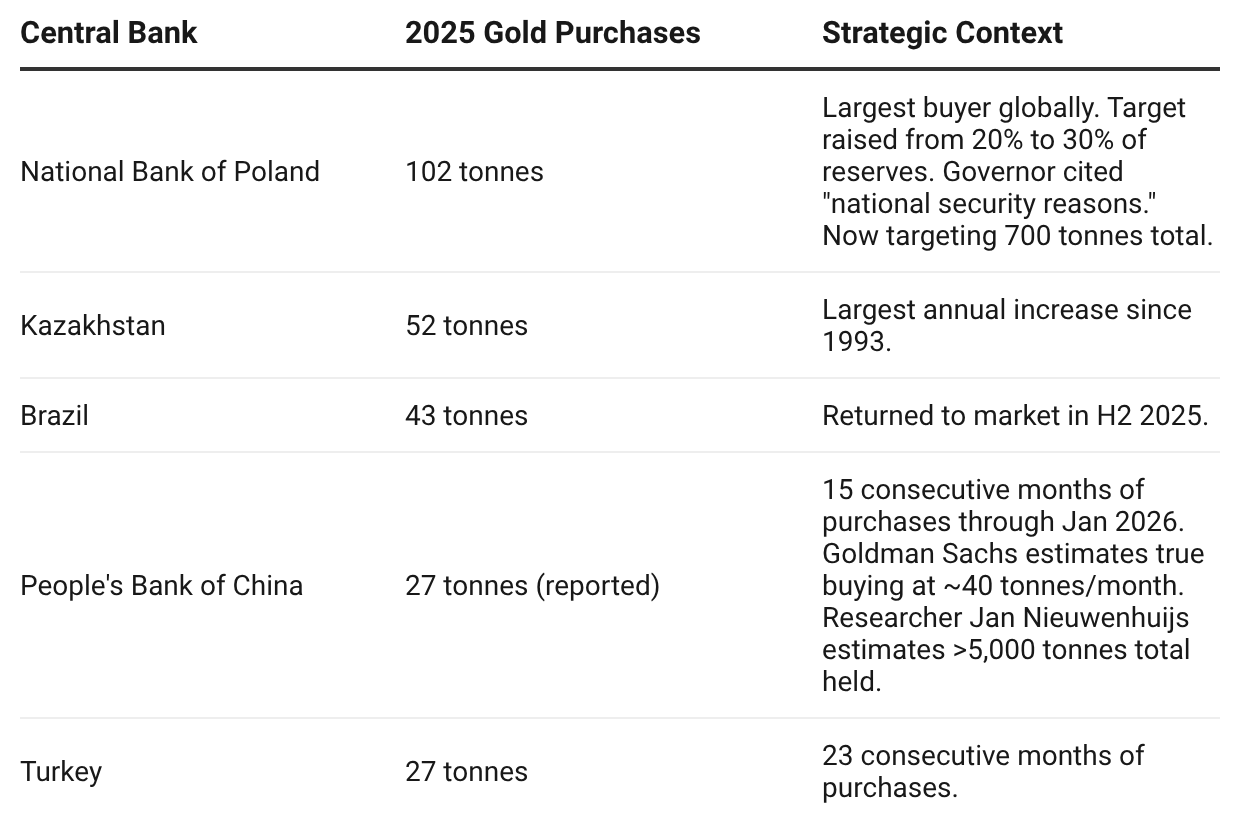
Full-year 2025 central bank purchases reached 863.3 tonnes (World Gold Council). While down 21% year-on-year, this remains far above the 2010-2021 average of 473 tonnes. Critically, 57% of 2025 central bank buying was unreported/opaque, suggesting substantially higher actual accumulation. Gold overtook US Treasuries as the world’s largest reserve asset by value in late 2025.
The Critical Distinction Bonzon Misses
The 2025 divergence is not evidence that Bitcoin has failed as an out-of-system asset. It is evidence that different types of out-of-system buyers have different purchase mechanisms.
Gold’s 2025 bid came from central banks making strategic, price-insensitive, sovereignty-driven purchases. These buyers do not care about short-term price action. They are building strategic reserves against the weaponisation of the dollar system, a process that accelerated dramatically after $300+ billion in Russian reserves were frozen in 2022.
Bitcoin’s 2025 flow was dominated by Western institutional investors accessing the asset through ETFs, products that are inherently sensitive to macro liquidity, risk appetite, and portfolio rebalancing. When risk-off conditions hit in Q4 2025, ETF investors reduced positions. This is a function of the access mechanism, not the asset’s fundamental properties.
The counterfactual Bonzon ignores: if his own Ukraine peace agreement scenario materialises and Russian assets are unfrozen, this would trigger profit-taking in both gold and Bitcoin. He applies this risk only to gold as a mild caveat, while using it to categorically exclude Bitcoin. This is analytically inconsistent.
Part 5: The Business Model Question
Bonzon concludes: “we prefer to err on the side of conservatism.” This framing deserves scrutiny not for its prudence, but for its alignment with institutional incentives.
Physical gold is an asset that banks can manage, custody, and charge fees on within existing infrastructure. Bitcoin in self-custody removes the bank from the value chain entirely. When Bonzon argues that Bitcoin no longer qualifies as digital gold, he is conveniently steering assets toward the one out-of-system asset that preserves traditional wealth management’s relevance and fee structure.
This is not a conspiracy theory. It is a structural incentive analysis. The quantum computing argument, which threatens all digital infrastructure (not just Bitcoin), is selectively applied. ECDSA underpins a vast portion of global financial infrastructure including TLS/SSL, banking authentication, and government communications. If quantum computing truly poses the imminent risk Bonzon implies, then the entire digital financial system is at risk, not just Bitcoin. Yet he applies this argument exclusively to dismiss the one asset that competes most directly with the products Julius Baer manages.
Part 6: Where We Actually Stand
An Honest Assessment
This report would fail its own standard of forensic rigour if it did not acknowledge the following:
Bitcoin is currently trading at approximately $67,000, down 47% from its October 2025 all-time high of $126,080. This is a significant correction that is causing real pain to investors.
The digital gold thesis is empirically dormant. Bitcoin’s correlation with gold is approximately zero. It is currently behaving as a high-beta tech risk asset. This is not what store-of-value advocates promised.
The quantum threat is real and deserves serious attention. It is not a dismissed conspiracy. It is an engineering challenge with a defined timeline.
US ETFs are net sellers in early 2026. CryptoQuant reports that institutional demand has materially reversed from a year ago.
But Bonzon’s Conclusion Does Not Follow From His Evidence
The question is not whether Bitcoin faces challenges. It does. The question is whether those challenges constitute a permanent, structural disqualification from the digital gold thesis. Bonzon argues yes. The evidence argues no.
Bitcoin’s scarcity is protocol-enforced and unchangeable. Its resistance to seizure in self-custody remains absolute. Its portability exceeds gold’s by orders of magnitude. Its divisibility makes it accessible to populations that cannot afford physical gold. Its protocol is actively upgrading to address quantum threats with NIST-standardised cryptography. These are structural properties that a single-year price drawdown and an as-yet-theoretical computing threat do not negate.
The honest conclusion is this: the digital gold thesis is not dead. It is in a cyclical dormancy driven by market structure, investor demographics, and macro regime. Bonzon has confused the weather for the climate.
"So, do I buy here, or wait?"
For long-term holders, the current regime offers accumulation opportunities; for traders, the Nasdaq correlation remains the dominant short-term driver.
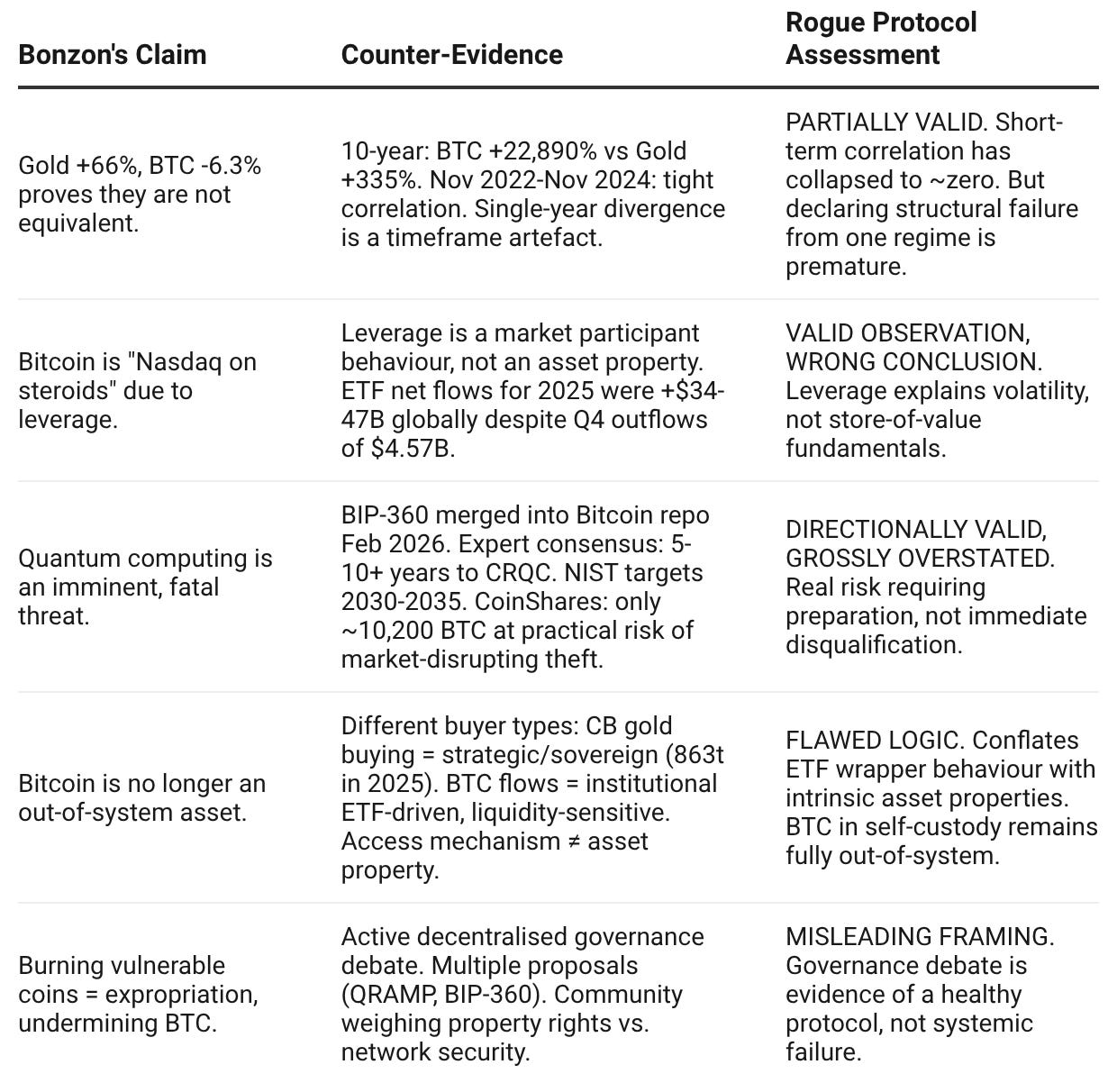
Appendix: Claim vs. Counter-Evidence
Data Sources
CME Group, OpenMarkets (March 2025; February 2026) • CoinShares: Quantum Vulnerability in Bitcoin (February 2026) • World Gold Council: Gold Demand Trends Full Year 2025 • CoinDesk: Bitcoin ETF outflows, BIP-360 merge coverage • Bloomberg: IBIT outflow data (December 2025) • SoSoValue: Spot Bitcoin ETF flow aggregation • Human Rights Foundation: The Quantum Threat to Bitcoin (November 2025) • Chaincode Labs: Bitcoin and Quantum Computing (May 2025) • CryptoQuant: Institutional demand analysis • ETFGI: Global Crypto ETF Insights (December 2025) • Fortune, CNBC, Reuters: Gold price reporting • Decrypt, Cointelegraph: BIP-360 and quantum development coverage