Stack BTC Plc — The Confirmation
What the Data Now Proves

The previous two analyses of Stack BTC Plc were constrained by what the public record did not yet show.
The Launch That Knew Better

A former Chancellor. A predecessor whose own disclosures describe an inability, at that time, to execute its investment objectives. A Bitcoin treasury company that hasn’t bought any Bitcoin. This is the forensic record of Stack BTC Plc - examined at the moment of its birth.

The March 3rd piece identified three possible explanations for deployment inaction and stated that the company’s own record would, in time, resolve which one was true.
The record has now resolved it.
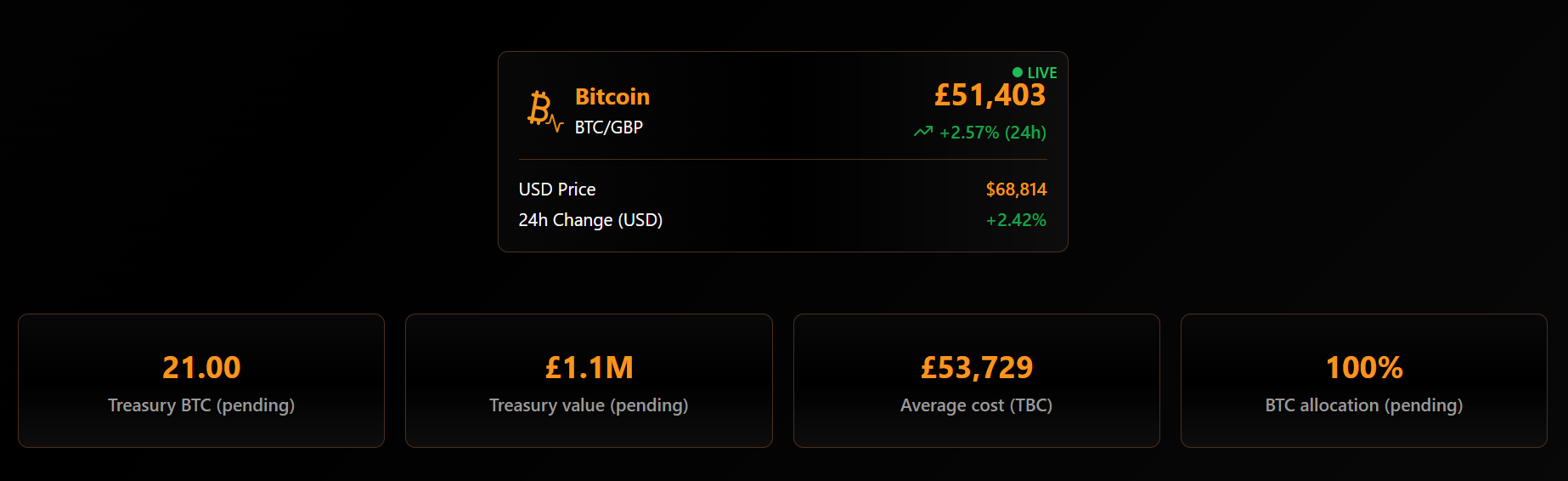
On 6 March 2026, the company announced its first Bitcoin purchase: 21 BTC at an average acquisition price of £53,729 per coin. On 9 March 2026, it announced strategic equity investments from Nigel Farage and Blockchain.com, raising a further £260,000 at 5p per share. The company’s live treasury dashboard, captured on the day of the Farage announcement, shows Bitcoin trading at £51,403, approximately £2,326 below the average acquisition cost.
Three data points. Each one answers a different analytical question that the prior record left open.
This article closes those questions.
Part I — The Market Timing Confirmation
The March 3rd analysis presented a binary. Bitcoin treasury strategy, as advanced by MicroStrategy and its successors, is premised on systematic accumulation regardless of price. Fear is not a reason to pause. Under the internal logic of the thesis, extreme fear is the optimal accumulation environment.
During the period between settlement (approximately 25 February) and the date of writing (3 March), the Fear and Greed Index reached a reading of 5, the lowest in Bitcoin’s recorded history. Lower than the 2018 bear market. Lower than the March 2020 COVID crash. Lower than the November 2022 FTX collapse. Bitcoin was trading below £50,000. The capital was available. No Bitcoin was purchased.
The three explanations offered were: market timing, governance failure, or a proposition that was never solely about Bitcoin. The company’s subsequent actions collapse that decision tree to one branch.
The average acquisition cost is £53,729.
Bitcoin’s documented floor during the extreme fear window was approximately £49,500–£50,000. The purchase was executed after sentiment began to recover, at a price approximately 7–8% above the historic fear trough. The gap is not large in absolute terms. It is definitive in analytical terms.
A board executing systematic accumulation does not buy at £53,729 when the asset was available at £49,500 six business days earlier. The sequence of events has one interpretation: the board waited for conditions to feel better before deploying. That is market timing. It directly contradicts the treasury accumulation thesis that is the stated intellectual foundation of the strategy, the basis on which investors funded the February raise, and the framing under which the company continues to describe itself.
The deployment inaction analysis did not need to speculate about motive. It needed to wait for the data. The data is now in the public record.
Part II — The FRS 102 Position: Impaired on Day One
The accounting consequence of the acquisition price is not a narrative observation. It is a statutory obligation.
Under FRS 102, Bitcoin is classified as an intangible asset and measured using the cost model. When Bitcoin’s market price falls below the price at which the company acquired it, an impairment charge must be recognised immediately in the profit and loss account. That charge flows through to retained earnings, reducing the pool of distributable reserves.
At the time of the Farage announcement on 9 March 2026, the live Bitcoin price was £51,403. The company’s average acquisition cost was £53,729. The unrealised loss per coin is approximately £2,326. Across 21 Bitcoin, the aggregate position is an unrealised loss of approximately £48,846.
Under US accounting standard ASU 2023-08, this position would be reported as a fair value movement, a negative mark-to-market, but symmetrical. When the price recovers, the gain flows back through the income statement. The position is live in both directions.
Under FRS 102, it is not symmetrical. The £48,846 loss must be recognised when the balance sheet is prepared. If Bitcoin recovers above £53,729, none of that recovery is recognised in the statutory accounts until the Bitcoin is sold. The company will carry an impairment charge on its profit and loss account from the date of its first acquisition. It will receive no corresponding credit if the price subsequently doubles.
This is not a hypothetical risk. It is the current arithmetic state of the company’s treasury, based on the figures shown on its own public dashboard on the day it announced its most prominent investor.
The company purchased Bitcoin, disclosed it publicly, and announced a high-profile investor on the same day it was already sitting on an unrecognised impairment charge. The FRS 102 framework is not an obscure technicality. It is the accounting standard that governs every UK company’s statutory reporting. Every adviser in the room on 9 March 2026 was operating in its context.
Part III — The Farage/Blockchain.com Deal: Anatomy of a Capital Event
The headline figure is £260,000, raised through the issue of 5,200,000 new ordinary shares at 5p per share. Nigel Farage invested via his wholly-owned vehicle, Thorn In The Side Ltd. Blockchain.com, a global crypto exchange and custody provider registered with the FCA, invested alongside him and entered into a strategic custody partnership with the company.
£260,000 is operationally immaterial to a company with approximately £1.2 million still undeployed from the February raise. The capital is not the point of this transaction. The three actual functions of this raise are profile, infrastructure, and optionality.
Profile. Farage is, at the time of writing, the leader of the Reform UK party and one of the most media-amplified political figures in Britain. His involvement in any commercial venture generates immediate, broad coverage in outlets that do not routinely report on Aquis Growth Market announcements. The announcement that “Nigel Farage backs UK Bitcoin company” produces retail attention that £260,000 cannot buy through any conventional marketing channel. His stated rationale, London as a global crypto hub, support for British SMEs maps directly onto Stack’s M&A acquisition narrative. He is a media engine, and his 6.31% stake provides the skin-in-the-game credibility required for that function to operate.
Infrastructure. Blockchain.com is an FCA-registered cryptoasset business. The announcement discloses that they have “entered into a strategic partnership to deliver institutional-grade custody services” for the company’s Bitcoin treasury. This is materially significant. The February analysis identified custody onboarding as a possible operational explanation for the deployment delay. The Blockchain.com partnership, in retrospect, provides partial context: the company may have been in the process of establishing its custody infrastructure during the period it was not buying Bitcoin. That does not explain why the acquisition price was £53,729 rather than £50,000. But it does suggest the custody question was being worked on in parallel with the capital deployment.
It also changes the regulatory optics in a meaningful way. Having an FCA-registered entity as a named custody partner provides a layer of institutional credibility that the company’s public record previously lacked. Blockchain.com having FCA registration is not the same as Stack BTC Plc having FCA authorisation. But it is a more defensible position than operating with an unnamed custody arrangement.
Optionality. The terms of the Blockchain.com investment are not fully disclosed in the RNS. The announcement states that Blockchain.com has both invested in the company and entered into the custody partnership. An equity investor who is also the custody provider has interests that are not purely aligned with minimising custody costs for existing shareholders. The fee structure of the custody arrangement, and whether it was agreed before or after the equity investment was negotiated, is not in the public record. That gap is not an allegation. It is a disclosed relationship whose terms are commercially sensitive and operationally significant, and whose complete structure is not yet visible.
The Warrant Structure. The strategic investors were issued warrants on a one-for-two basis, exercisable at 5p, the same price as the fundraise from the earlier of 21 January 2028 or five consecutive trading days above £100 million market capitalisation. This creates a mechanically precise dynamic: if the Farage announcement generates sustained retail buying pressure and the share price rises, the same investors who drove that price increase can double their position at their original entry price. The dilution is built into the structure of the transaction that caused the price increase.
Part IV — The Updated Dilution Arithmetic
The post-admission share count is 68,130,000 ordinary shares. The capital structure has become more complex, not less, since the February analysis.
The original structural analysis identified 500 million shares of non-pre-emptive authority as the dominant arithmetic feature. That authority has not been cancelled. It has not been partially exercised in a way that reduces it. Every new share issued since the December GM has been issued against that unchanged authority backdrop.
The full dilution picture now reads as follows:
Component Share Count Dilution Against Current Issue Shares currently in issue 68,130,000 Baseline Non-pre-emptive authority (Dec 2025 GM) 500,000,000 ~734% Concert party warrants (1p exercise price) 20,600,000 ~30.2% New strategic investor warrants (5p exercise price) 2,600,000 ~3.8% Combined maximum 591,330,000 ~768%
The 1p concert party warrants deserve specific attention in the current context. As of 9 March 2026, the shares are trading materially above 1p, almost certainly in the range of 7–10p following the Farage announcement, given the report in Financial News of a 60%+ intraday surge. Every penny of price appreciation above 1p represents intrinsic value in those warrants. Full exercise of the 20.6 million concert party warrants at 1p introduces 20.6 million new shares at a cost basis that is approximately 7–9p below the current market price, immediately diluting all existing holders by approximately 30% while transferring that value differential to the warrant holders.
The 5p strategic investor warrants operate differently but similarly. They are exercisable at 5p. If the share price holds above 5p, which the Farage announcement appears to have achieved today, those warrants carry intrinsic value from the moment of exercise eligibility. The mechanism is structural. It does not require any bad faith on the part of any individual. It operates because the warrants exist.
The NAV arithmetic is unchanged in its fundamental character. At the current Bitcoin price of £51,403 and holdings of 21 BTC, the Bitcoin NAV of the treasury is approximately £1,079,463. Spread across 68,130,000 shares in issue, the Bitcoin NAV per share is approximately 1.58p. The February raise was priced at 5p. The Farage announcement has apparently driven the share price significantly above that level. The gap between share price and Bitcoin NAV per share is widening, not narrowing. A widening premium is the condition under which the dilution authority is most likely to be exercised.
Part V — The SWC Structural Comparison: Updated
The Smarter Web Company is no longer a theoretical benchmark. It is a live case study in late-stage structural distress.
SWC raised £222 million, accumulated 2,689 Bitcoin, reached an mNAV premium of approximately 25x at its peak in late 2025, and has since watched that premium collapse to approximately 0.90x. Its Bitcoin Yield, the metric it used to demonstrate accretive share issuance, turned negative at -0.54% in Q1 2026. It has established a $30 million Bitcoin-backed credit facility with Coinbase, introducing liquidation risk to its entire treasury. It moved to the LSE Main Market in February 2026, increasing its cost structure at precisely the moment its premium collapsed and its self-financing mechanism broke.
Stack BTC Plc replicates the following structural features of SWC:
A controlling concert party with a significantly lower cost basis than external investors. A warrant overhang creating structural price suppression above the exercise level. A gap between share price and Bitcoin NAV per share that depends on sustained market premium to remain investible. An operating business component, in SWC’s case a web design agency, in Stack’s case an M&A pipeline, that is either insufficient or unproven to cover the PLC’s fixed cost structure. An absence of access to institutional convertible debt that could provide non-dilutive financing during periods of price stress.
The differences are also real. Stack’s M&A strategy is a genuine theoretical improvement over SWC’s model. Stack has the Blockchain.com custody partnership, which SWC did not have at launch. Stack has raised £2.32 million rather than £222 million, which limits the immediate damage if the structure fails. And Stack is operating in the environment created by SWC’s failure, meaning the analytical framework for what goes wrong is now fully documented in the public record. The directors of Stack BTC Plc can read exactly what happens when the premium collapses and the operating floor is insufficient.
What Stack has not done is structurally resolve any of the mechanisms that caused SWC’s distress. The M&A strategy remains unexecuted: no targets have been identified in any RNS or regulatory filing as of today’s date. Until the first acquisition closes and generates verified cash flow to the holding company, the “operating floor” exists in the same state it did on 21 January: as a stated intention.
The PLC overhead arithmetic has not improved. Annual fixed costs of approximately £200,000–£300,000 remain. The acquisition budget available after Bitcoin deployment and working capital reservation is approximately £1 million. At current mid-market multiples of 4–8x EBITDA, that buys approximately £125,000–£250,000 of annual EBITDA before debt service and subsidiary working capital. Realistic upward cash flow to the holding company of £75,000–£150,000 is an optimistic assumption. The holding company is cash flow negative from the day the first acquisition completes, before a single additional Bitcoin purchase. That arithmetic has not changed because Nigel Farage now owns 6.31% of the company.
Part VI — The 2027 Regulatory Timeline: It Has Now Moved
The February analysis identified the FCA’s cryptoasset authorisation regime as a forward risk. It is now more proximate than it was.
On 4 February 2026, the UK government made the Financial Services and Markets Act 2000 (Cryptoassets) Regulations 2026. The regime commences 25 October 2027. The FCA’s authorisation gateway opens 30 September 2026, six months from today. Applications must be submitted by 28 February 2027 or the firm must cease regulated cryptoasset activities.
The regulatory question for Stack BTC Plc is whether its Bitcoin Treasury Education Centre constitutes regulated activity. Section 21 of FSMA prohibits the communication of an invitation or inducement to engage in investment activity unless the communicator is FCA-authorised. The FCA’s analysis turns on effect, not label. Educational content that, in substance, moves a director toward Bitcoin treasury adoption may constitute an inducement regardless of how it is framed. Stack BTC Plc is not an FCA-authorised firm.
The Farage announcement changes this calculation in a specific way. Before today, Stack’s Education Centre was the commercial outreach of a company with 59 LinkedIn followers. After today, it is the educational resource of a company associated with one of Britain’s most prominent political figures, operating a custody arrangement with an FCA-registered counterparty, and generating press coverage in the Financial Times adjacent press. The audience for that content has materially expanded. The probability that the FCA will scrutinise it has increased proportionally.
The authorisation window and the M&A liquidity squeeze identified in the February analysis both converge at approximately the same point: twelve to eighteen months from now. The Farage announcement has accelerated the profile trajectory without changing the cash flow arithmetic. These timelines are not independently manageable.
Conclusion: What the Record Now Shows
Three months ago, Kasei Digital Assets PLC was a failed digital asset fund proposing to restructure as a Bitcoin treasury company. The Rogue Protocol examined that restructuring at the moment of its birth and identified the structural vulnerabilities in the capital architecture, the accounting treatment, and the governance framework.
The primary source record as of 9 March 2026 shows the following observable facts, each documented and date-stamped:
The company raised £2.32 million to buy Bitcoin. It had access to that capital during the lowest sentiment reading in Bitcoin’s recorded history. It did not buy during that window. It subsequently bought at £53,729 per coin. The current price is £51,403. The company’s treasury is already impaired under FRS 102 on the day it announced its most high-profile investor.
The 500 million share non-pre-emptive authority granted in December 2025 remains in place and has not been reduced. The concert party warrants at 1p remain exercisable. New warrants have been added at 5p. The combined maximum dilution of existing shareholders has not decreased; it has increased.
The M&A strategy, the single genuine structural innovation in Stack’s design, has produced no announced targets in the forty-seven days since the company resumed trading. The operating floor it is designed to create does not yet exist.
The Farage and Blockchain.com investments are real events with real implications for the company’s profile and custody infrastructure. Neither resolves the dilution arithmetic, the FRS 102 impairment position, the M&A execution gap, or the 2027 regulatory timeline.
The forensic criteria established in the February analysis were: first acquisition announcement, first Bitcoin purchase disclosure, first audited accounts. The Bitcoin purchase has now been made and can be evaluated. The evaluation is straightforward.
The company bought Bitcoin after the floor. It is currently underwater. It did so under an accounting standard that requires the loss to be recognised and prohibits the gain from being shown. It announced this position on the same day as its highest-profile investor.
The share price appears to have responded positively to the Farage announcement. Share price is not the analytical variable. Bitcoin NAV per share, currently 1.58p on a share price that, until today, was 5p and may now be higher, is the analytical variable. As the share price rises, the Bitcoin NAV per share does not. What rises is the premium. And a rising premium, in this capital structure, is the condition under which the dilution authority is most valuable to exercise.
The February analysis concluded that Stack BTC Plc was a company marketing a Bitcoin treasury strategy that had raised £2.32 million, watched investors fund it at the worst Bitcoin sentiment in recorded history, and had deployed none of that capital in the six business days since settlement, while holding authority to dilute existing shareholders by approximately 800%.
The March update is more specific. The company has now deployed approximately half its capital at a price that is already impaired. It has onboarded a high-profile investor whose primary function is narrative amplification. It has established a custody arrangement whose terms are partially undisclosed. And it has done all of this while the 500 million share authority sits unexercised, the concert party warrants at 1p remain in place, and the M&A pipeline remains empty.
The story is louder. The arithmetic has not changed.
Addendum — The Prior Relationship
Since publication, the following has been verified from the public record.
Stack BTC Plc was founded by Paul Withers, who is also the founder of Direct Bullion, a gold dealer. Direct Bullion previously recruited Nigel Farage to front advertising campaigns encouraging retail investors to buy gold. Farage has declared total payments of £415,500 from Direct Bullion. Withers described Farage at the time as “a real goldbug” who was “bringing the customers to us.”
The 9 March 2026 announcement is therefore not the first commercial relationship between Withers and Farage. It is the second. The structure is identical: an alternative asset vehicle, Farage as the retail-facing endorsement, the same retail audience.
The conflict of interest analysis in Part III of this piece identified the Farage involvement as a media amplification function. That analysis was based on the public record available at the time of writing. The prior Direct Bullion relationship is a material addition to that analysis. It does not change the accounting arithmetic. It changes the context in which the narrative amplification function should be understood.
Stack BTC Plc is also chaired by Kwasi Kwarteng, the former Chancellor of the Exchequer whose September 2022 mini-budget triggered a severe gilt market dislocation and whose tenure at the Treasury lasted 38 days.
The record now shows what it shows.
The forensic framework behind this analysis is documented in full in The UK Bitcoin Treasury Reality, published by The Rogue Protocol in March 2026. It covers the four structural reasons the MSTR model does not translate to the United Kingdom - FRS 102 accounting asymmetry, HMRC's treatment of every disposal as a chargeable event, the absence of institutional capital markets access, and the personal director liability exposure under the Companies Act 2006 and Insolvency Act 1986. It includes the Smarter Web Company as a live case study, a seven-condition framework for when a UK Bitcoin treasury allocation could be legitimate, and a Director's Reality Check that identifies specific legal and financial exposures in binary form. Available at
paulfaulkner.com/bitcoin-treasury-reality