
The UK Bitcoin Treasury Trap
Why the Strategy Inc. Model Fails in Britain

The Great British Pivot and the Systemic Illusion
The landscape of the United Kingdom’s junior public markets, particularly the Aquis Stock Exchange (AQSE) and the Alternative Investment Market (AIM), is currently the staging ground for a radical, systemic, and legally precarious transformation.
A growing cohort of small-cap enterprises, often characterised by stagnant legacy operations in sectors ranging from web design to helium exploration and whisky distillation, are restructuring their balance sheets to adopt a “Bitcoin Standard.”
This strategic pivot, heavily inspired by the corporate treasury model pioneered by the US-based software company Strategy Inc., involves leveraging public equity markets to raise capital for the explicit purpose of accumulating Bitcoin (BTC) as a primary treasury reserve asset.
Proponents of this model - often termed the “Bitcoin Treasury” strategy - argue that it unlocks shareholder value by arbitraging the fundamental disconnect between fiat-denominated equity capital, which is subject to inflationary debasement, and the deflationary, capped-supply mechanics of digital assets.
The narrative suggests that by issuing equity to purchase Bitcoin, companies can create a virtuous cycle or “flywheel” of accretion, where the rising value of the treasury asset supports higher share prices, enabling further non-dilutive capital raises to acquire more assets.
However, a forensic legal and accounting analysis reveals that this strategy is fundamentally flawed when transplanted into the UK jurisdiction.
The “Strategy Inc. Model” - which is predicated on the ability to recognise unrealised crypto-asset gains as income to support equity valuations and debt issuance under US GAAP - is rendered structurally incompatible by the United Kingdom’s strict capital maintenance rules and accounting standards.
Specifically, the interplay between Financial Reporting Standard 102 (FRS 102), International Financial Reporting Standards (IFRS), and Part 23 of the Companies Act 2006 creates an “Accounting Kill-Switch” that prevents the creation of distributable reserves from Bitcoin price appreciation.
This effectively creates a liquidity trap where companies may show asset growth on paper but remain legally incapable of returning that value to shareholders via dividends or buybacks without liquidating the underlying treasury, thereby defeating the strategy’s primary objective.
Furthermore, the execution of these strategies often relies on the guidance of “Bitcoin Corporate Treasury Advisors” - external consultants who are frequently unregulated and driven by ideology rather than compliance.
This report posits that the reliance on such advisors exposes directors to severe criminal and civil liabilities under the Financial Services and Markets Act 2000 (FSMA) and the Companies Act 2006.
With the impending implementation of the Financial Services and Markets Act 2000 (Regulated Activities and Miscellaneous Provisions) (Cryptoassets) Order 2025, the regulatory perimeter is closing with force.
Activities previously considered “grey market” consultancy are transitioning into definitive criminal offences, creating an “FSMA Trap” for unwary boards.
This report provides a comprehensive, forensic analysis of these systemic risks.
I utilise evidence from the uploaded LinkedIn debate between myself and unregulated advisor Anthony Ward, as well as detailed case studies of entities such as The Smarter Web Company (SWC) and Nakamoto Holdings.
It concludes that the UK Bitcoin Treasury model, as currently constituted, is a structurally flawed strategy that creates a material risk of exposing directors to criminal and civil liabilities and significant regulatory enforcement if they fail to exercise the objective diligence required by law.
The Strategy Inc. Paradigm vs. The UK Reality
To understand the severity of the risk facing UK investors and directors, one must first deconstruct the economic logic of the model they are attempting to replicate and identify precisely why it fails to translate across the Atlantic.
The divergence is not merely one of market depth or investor appetite, but of fundamental legal architecture.
1.1 The US Model: The Accretion Flywheel
The “Strategy Inc. Model,” championed by Michael Saylor, relies on a specific and highly favourable interaction between US Generally Accepted Accounting Principles (US GAAP) and the deep, liquid US capital markets.
The mechanism operates as a continuous flywheel of value creation, dependent on the accounting recognition of asset appreciation.
The process begins with the company issuing convertible senior notes or equity at a premium to the Net Asset Value (NAV) of its Bitcoin holdings.
The proceeds from this issuance are immediately deployed to purchase Bitcoin.
The critical catalyst for the model lies in the accounting treatment.
Under the newly adopted FASB ASU 2023-08, US companies can elect to measure crypto assets at fair value.
Crucially, changes in fair value - specifically, unrealised gains from price appreciation - are recognised immediately in Net Income (Profit & Loss).
This accounting treatment allows the company to report massive “profits” driven solely by the market appreciation of its treasury assets.
These profits swell the company’s Retained Earnings and Earnings Per Share (EPS) metrics, creating a perception of robust financial health and profitability that is independent of the underlying operating business (software sales).
This accounting-driven profitability supports high equity valuations, which in turn allows the company to issue more debt or equity at attractive rates to buy more Bitcoin.
It is a self-reinforcing loop where the accounting standards actively facilitate the strategy.
1.2 The UK Reality: The Broken Transmission Mechanism
The fundamental error made by UK directors and their unregulated advisors is the assumption that this financial engineering is jurisdiction-agnostic.
It is not. The UK legal and accounting framework contains structural barriers - specifically designed to protect creditors and ensure capital maintenance - that sever the link between asset appreciation and distributable capital.
In the UK, the “flywheel” faces immediate mechanical failure due to the rigid legal divergence between Realised Profits (the only lawful source of dividends and buybacks) and Unrealised Gains (where Bitcoin appreciation resides).
Unlike the US system, where fair value gains flow to Net Income, the UK system traps these gains in non-distributable reserves.
This failure is compounded by the core accounting asymmetry under IAS 38: because crypto‑assets such as Bitcoin are treated as intangible assets with an indefinite useful life, prior impairments cannot be reversed under IAS 36. At the same time, any unrealised upward revaluations must be recognised in Other Comprehensive Income (OCI) and accumulated in a non‑distributable revaluation reserve, while any subsequent impairments or losses must be recognised immediately in the Profit & Loss (P&L) account.
The combined effect is that a UK company cannot lawfully use Bitcoin price appreciation to create distributable reserves or to fund dividends or share buybacks, removing the primary mechanism Strategy Inc. relies on to manage its discount to NAV and reward shareholders.

Evidence of this systemic misunderstanding is found in the public discourse surrounding these equities.
In the provided LinkedIn debate, the challenge posed by me regarding the reconciliation of capital maintenance rules with the Bitcoin treasury model was met with deflection rather than a technical answer.
This refusal to engage with the black-letter law of the Companies Act 2006 suggests a “competence gap” in the sector, where the narrative of “number go up” is allowed to supersede the legal reality of “profits available for distribution.”
The following table summarises the critical divergence between the two jurisdictions, highlighting why the UK model is structurally incapable of replicating the US success:
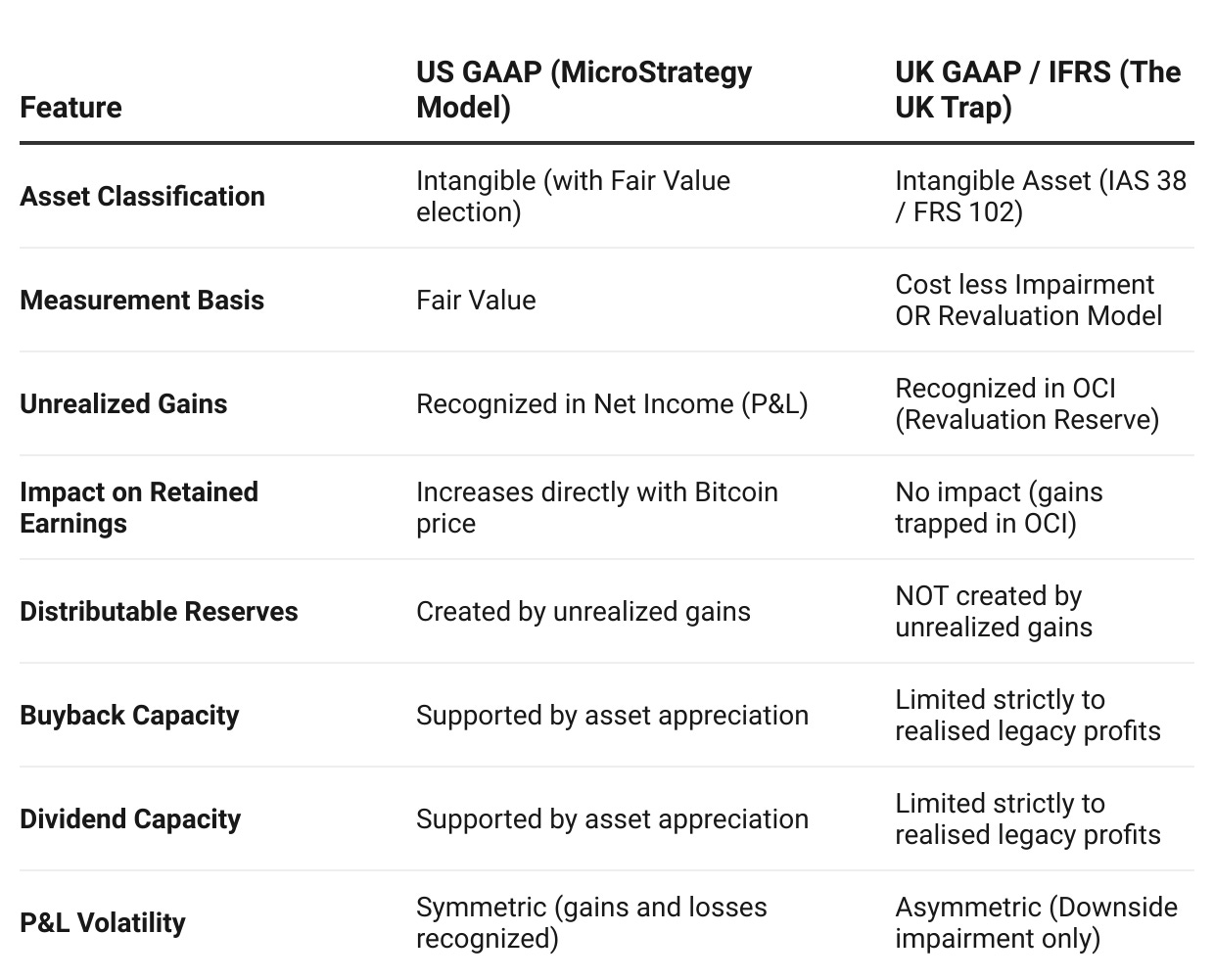
Forensic Accounting Analysis: The “Accounting Kill-Switch”
The primary barrier to replicating the Strategy Inc. model in the UK is not regulatory hostility towards Bitcoin itself, but rather the rigid application of UK GAAP (FRS 102) and International Financial Reporting Standards (IFRS) regarding the treatment of intangible assets and the statutory definition of distributable profits.
This section provides a deep dive into the specific accounting standards and legal provisions that constitute the “Accounting Kill-Switch.”
2.1 Classification and Measurement: The Intangible Trap
In the United Kingdom, crypto-assets do not meet the definition of a financial instrument or cash equivalent under IAS 32 or FRS 102. They are universally classified as Intangible Assets in accordance with IAS 38 and FRS 102 Section 18.1 This classification is the first step in the trap, as it forces companies to choose between two measurement models, both of which are fatal to the “treasury yield” narrative commonly sold to investors.
2.1.1 The Cost Model (Cost less Impairment)
Under the Cost Model, assets are held at their historic purchase price.
If the market price of Bitcoin falls below this carrying amount, the difference must be immediately recognised as an Impairment Loss in the Profit & Loss (P&L) account.
However, if the Bitcoin price rises, the gain is ignored for accounting purposes.
It cannot be recognised in the accounts until the asset is physically sold to a third party.
This asymmetry is structurally unavoidable, as Bitcoin, classified as an intangible asset with an indefinite useful life under IAS 38, is not permitted to reverse previous impairment losses even if the market price subsequently recovers.
(While FRS 102 allows reversals for intangibles with finite lives, this exception does not apply to Bitcoin’s specific classification).
This crushes earnings per share metrics and makes the company appear less profitable than it might be, failing to support the premium valuation required for the flywheel to operate.
2.1.2 The Revaluation Model (The “Trap”)
To avoid the optical failure of the Cost Model, some companies, such as The Smarter Web Company (SWC), may attempt to use the Revaluation Model to reflect the current market value of their Bitcoin holdings.
While this allows the balance sheet to look healthier by showing the asset at its fair value, it triggers the “Accounting Kill-Switch” regarding distributions.
Under FRS 102 Section 18.18 and IAS 38, increases in the carrying amount of an intangible asset arising from revaluation must be recognised in Other Comprehensive Income (OCI) and accumulated in a separate component of equity called the Revaluation Reserve. Crucially, these gains are not recognised in Profit or Loss (P&L).
Therefore, they do not flow into Retained Earnings.
2.2 The Capital Maintenance Barrier: Part 23 Companies Act 2006
The accounting treatment described above interacts fatally with UK company law.
The legal definition of “profits available for the purpose” of distribution (which includes both cash dividends and share buybacks) is strictly defined in Section 830 of the Companies Act 2006.
Section 830(2): “A company’s profits available for distribution are its accumulated, realised profits, so far as not previously utilised by distribution or capitalisation, less its accumulated, realised losses...”.
This statutory requirement is the “Kill-Switch.” Because unrealised gains on Bitcoin (whether recognised under the Cost Model or the Revaluation Model) are legally defined as unrealised profits, they are strictly undistributable.
The Institute of Chartered Accountants in England and Wales (ICAEW) guidance TECH 02/17BL confirms that unrealised increases in the fair value of assets do not constitute realised profits.7
Therefore, a UK Bitcoin Treasury company faces a scenario where:
Bitcoin Price Rises: The asset value on the balance sheet increases (under the Revaluation Model).
Equity Increases: The Revaluation Reserve (in Equity) swells.
P&L Stagnates: The Profit & Loss account remains flat or turns negative due to corporate operating costs.
Distributable Reserves: No distributable reserves are created.
This creates a liquidity trap. A UK company could theoretically hold £1 billion in unrealised Bitcoin gains but be legally insolvent on a distributable basis, unable to pay a £1 dividend or buy back a single share without selling the underlying Bitcoin.
Selling the Bitcoin would trigger Corporation Tax and defeat the “HODL” strategy that underpins the investment thesis.
Unlike Strategy Inc., which can use accounting gains to buy back shares and support its stock price, a UK entity is legally impotent to defend its valuation using its treasury assets.
2.3 Evidence of the Knowledge Gap: The Faulkner-Ward Debate
In the current financial landscape, the line between “innovative treasury strategy” and “reckless corporate gambling” is increasingly blurred by unregulated actors.
This report documents a specific case study: a public confrontation on LinkedIn between myself, and Anthony Ward (a self-styled “Bitcoin Treasury Advisor”).
The interaction serves as a microcosm of a broader systemic risk: the importation of US-centric, high-volatility asset strategies (specifically the “Strategy Inc. Model”) into the UK corporate environment, often by individuals lacking the requisite regulatory authorisation or technical accounting literacy.
This report will demonstrate, through a line-by-line forensic breakdown, how Ward’s offering dissolves when subjected to the mechanical stress tests of UK Company Law (specifically Capital Maintenance rules) and UK GAAP/IFRS accounting standards.
It will further analyse the psychological and rhetorical tactics used by Ward to evade substantive scrutiny - shifting from “educational commentary” to personal attacks when the arithmetic failed to support his narrative.
The Subject: Anthony Ward
Before dissecting the interaction, we must establish the credentials of the counterparty.
Credibility in corporate treasury is not derived from enthusiasm; it is derived from qualification, authorisation, and track record.
3.1 Background & Qualifications
According to his public LinkedIn profile, Anthony Ward’s primary professional certification is an EASA Part 66 Aircraft Maintenance Licence.
His education was completed at Northbrook College, Shoreham Airport Campus.

While aviation engineering requires admirable precision, the documentation shows that Mr. Ward lacks the regulatory and accounting qualifications required for providing complex corporate treasury advice, having no accreditation from bodies such as the ICAEW, ACCA, CIMA, or ACT (Association of Corporate Treasurers).
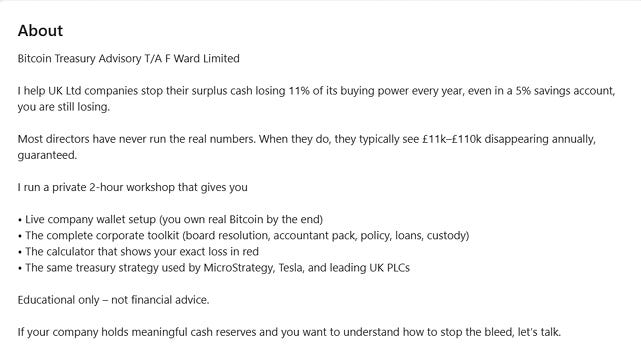
Yet, his headline reads: “Bitcoin Treasury Advisory | Protecting UK corporate cash from the silent 11% annual bleed”.

3.2 The Business Offering and Regulatory Exposure
Ward’s business model is a classic “High-Ticket Consultant” funnel, seemingly designed to bypass regulatory scrutiny while selling complex financial products.
The Hook: He utilises fear-based marketing, framing inflation as a “silent 11% annual bleed”.
This targets the anxiety of SME directors who feel their cash reserves are eroding.

The Product: He sells a “private 2-hour workshop”. This is significant. A workshop is ephemeral; it avoids the paper trail of a formal advisory retainer.
The Promise: The workshop includes a “Live company wallet setup” (ensuring the client owns real Bitcoin by the end) and a “complete corporate toolkit” including board resolutions, accountant packs, policies, loans, and custody.
The Disclaimer: He explicitly states, “Educational only, not financial advice”.
Note: Providing a “board resolution” and an “accountant pack” for the specific purpose of purchasing a volatile asset strays dangerously close to “arranging deals in investments” (Article 25 RAO) or providing specific advice.
The “educational” label is a thin veneer.
The Interaction: A Forensic Breakdown
The following analysis tracks the conversation chronologically. My objective was not to debate the merits of Bitcoin as an asset, but to stress-test the legal and accounting mechanisms Ward was selling to UK directors.
4.1 The Opening Salvo: Regulatory Status
I asked:
“Firstly, could you clarify your regulatory status for UK corporate directors reading this? Are you authorised under FSMA to provide financial promotions or treasury-related advice, or is this intended purely as unregulated educational commentary?”
Ward’s Response:
“Paul, spot on question, transparency first. I’m not authorised under FSMA, don’t provide advice or promotions, and everything here is unregulated educational commentary on public strategies like Strategy Inc.’s.”

Analysis:
Ward immediately concedes he is unregulated. He uses the “transparency first” linguistic softener to appear cooperative.
However, he then attempts to pivot the conversation instantly: “What’s your view on BTC?”
This is Tactical Deflection #1. He wants to move the battleground from Regulation (where he is weak) to Ideology (where he is comfortable).
He wants a debate about “Magic Internet Money,” not “Section 21 of FSMA.” I did not take the bait.
4.2 The Core Probe: Capital Maintenance & Distributable Reserves
I ignored his question about my view on BTC and struck at the heart of his “Treasury Strategy.”
I responded:
“This thread isn’t about BTC, it’s about BTC treasury... You’re offering workshops and a ‘corporate toolkit’... So, for UK companies considering a Bitcoin treasury, how do you reconcile the Companies Act capital-maintenance rules, specifically the prohibition on distributing unrealised gains with the fact that Bitcoin’s fair-value increases cannot create distributable reserves under UK GAAP or IFRS?”
“Without distributable reserves, how would a UK company legally fund dividends or coupon-style payouts from a Bitcoin treasury?”
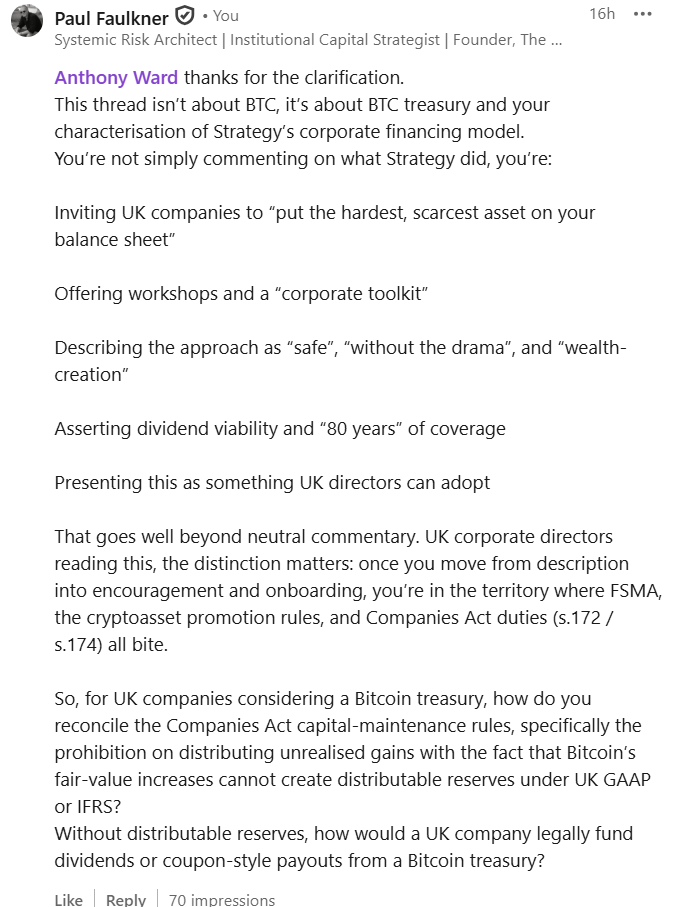
The Mechanics of the Question:
This is the “Black Swan” for the UK Bitcoin Treasury narrative.
Strategy Inc. (US) uses US GAAP. Under US rules, fair value gains can flow through to Net Income in ways that support their specific debt issuance models.
UK Companies are bound by the Companies Act 2006.
A dividend can only be paid from “distributable reserves” (realised profits).
The Trap: If a UK company buys Bitcoin, and it goes up 100%, that gain is unrealised.
It sits in a revaluation reserve (or similar OCI bucket).
It cannot be legally distributed to shareholders as cash without selling the asset.
Ward’s pitch implies a “flywheel” where you hold the asset forever but still generate wealth for shareholders.
In the UK, that is mathematically and legally impossible for a dividend-paying entity without selling the underlying corn.
4.3 Ward’s First Evasion: The “Appeal to Popularity”
Ward’s Response:
“UK companies already live with BTC treasuries under UK GAAP/IFRS and Companies Act rules: SWC... Satsuma... B HODL... Phoenix... All raise fiat first, buy BTC, keep cash buffers for ops/dividends. Unrealised gains stay unrealised and non-distributable. Same as holding any other asset.”

Analysis:
Ward walks right into the trap.
He admits the gains are non-distributable, “Unrealised gains stay unrealised and non-distributable”.
The Contradiction: If the gains are non-distributable, then his “Treasury Strategy” is dead weight.
If the Bitcoin goes up, the company cannot use that growth to pay dividends unless they sell it.
If they sell it, they aren’t “HODLing” like Strategy Inc.
The Logical Fallacy: He lists companies (SWC, Satsuma) as if their existence proves the strategy works.
As we will see, SWC is actually a cautionary tale.
4.4 Pressing the Point: The “Dividend” Gap
I refused to let him slide, pressing the point
“Holding Bitcoin is not the issue. The question is how a UK company running a Bitcoin treasury model can legally generate distributable reserves... Strategy can do this under US GAAP... UK companies cannot. So the question stands: How does a UK company legally fund dividends... without selling the underlying Bitcoin?”

4.5 Ward’s Second Evasion: The Ad Hominem & The Retreat
Realising he was cornered on the accounting mechanics, Ward shifted tactics entirely.
He stopped trying to explain the maths and started attacking the questioner.
Ward’s Response:
“Paul, three facts: UK dividends come from cash raised or operating profits, never unrealised OCI gains... Every UK BTC treasury company has a real operating business (SWC = web agency...)... That cash flow pays yields... I read your bio ‘Death Spiral’ audit on Strategy Inc, selling forensic fear reports to institutions terrified of Bitcoin. That explains the agenda. At this point, the discussion is circular, so I’ll leave it there. Goodnight.”

Analysis:
This response is revealing.
The Goalpost Shift: He claims dividends come from “operating profits” (e.g., SWC’s web agency work).
If the dividends come from the web agency, then the Bitcoin is irrelevant. The Bitcoin is not “powering” the dividend; the web agency is. He has just admitted his “Bitcoin Treasury” adds no liquidity value to the shareholder distribution model.
The Attack: He researched my background to find my work on “Death Spiral” financing.
He frames forensic due diligence as “selling fear”. This rhetorical attack serves to mask the reality that Mr. Ward demonstrates a misunderstanding of capital maintenance law by failing to reconcile the prohibition on distributing unrealised gains with his “Treasury Strategy” “You’re just a hater.”
The Exit: He attempts to terminate the conversation (” Goodnight”) to avoid answering the question.
4.6 The Smarter Web Company (SWC)
I brought up SWC to show why his narrative is dangerous:
“SWC collapsed because once the share price fell below NAV, the Bitcoin treasury model became mathematically impossible, issuing shares at a discount destroys value... The accounts said, ‘the PLC burns more cash than the business earns.’
When narrative and maths diverge, maths wins. Always.”

“And throughout this thread, every time the questions touched accounting capital-maintenance... you diverted. Not one of those questions was answered.”
4.7 Ward’s Final Stand: The “Audited Filings” Black Box
Ward’s Response:
“Paul, the audited filings already answer every point you’re raising. Strategy Inc. continues performing... and directors can read the numbers for themselves.”

Analysis:
Ward invokes “Audited Filings” as a magical talisman. He assumes that because a company is audited, it validates his specific interpretation of the strategy.
He cannot cite where in the filings the answer lies because the answer (that UK companies can distribute unrealised crypto gains) does not exist.
Psychological & Tactical Analysis
5.1 The “Expertise Mimicry”
Ward uses the language of high finance (” Treasury,” “Board Resolution,” “Yield,” “Flywheel”) to cloak a product that is essentially “Buy Bitcoin and Hope.”
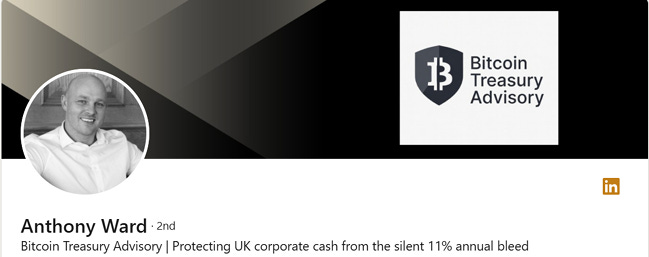
His LinkedIn banner mentions “Protecting UK corporate cash”, positioning himself as a guardian.
This mimics the posture of a regulated risk manager, yet he lacks the foundational knowledge (Capital Maintenance) to execute that protection legally.
5.2 The “Narrative vs. Arithmetic” Conflict
Ward operates in the Narrative domain: Bitcoin is the hardest asset; fiat is bleeding; get on the lifeboat.
I operate in the Arithmetic domain: Show me the distributable reserves; show me the NAV calculation; show me the solvency statement.
When these two worlds collide, the Narrative agent (Ward) experiences cognitive dissonance.
He cannot solve the arithmetic equation, so he attacks the Arithmetician (me) as “fearful” or “agenda-driven.”
5.3 The Mechanism of Liability: “Educational” Execution
To understand the risk, one must look at the specific product being sold to UK Directors. The advisory offering is structured not as a retained professional service, but as a “High-Ticket Workshop” designed to bypass regulatory scrutiny.
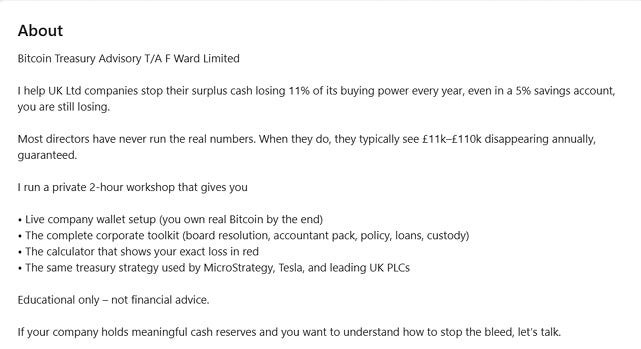
According to public marketing materials, the offering includes:
“Live company wallet setup” (explicitly promising ownership of the asset by the end).
“The complete corporate toolkit” (providing specific board resolutions and accountant packs).
The Compliance Red Flag: “Guaranteed” Losses
Perhaps the most dangerous aspect of this advisory model is the specific language used to funnel directors out of safe, yield-bearing cash and into volatile crypto-assets.
In his public offering, the Ward states:
“Most directors have never run the real numbers. When they do, they typically see £11k–£110k disappearing annually, guaranteed.”
The Forensic Deconstruction:
The “Guarantee” Trap: Under the FCA’s financial promotion rules, the use of the word “guaranteed” is strictly controlled. Claiming a “guaranteed” loss of purchasing power assumes a fixed, unchangeable inflation rate that exceeds the “5% savings account” yield he cites. This is economically false; inflation fluctuates.
The Phantom Inflation: To arrive at an 11% “bleed” against a 5% risk-free rate, the advisor is implicitly asserting a real inflation rate of 16%. This is a fabricated metric designed to trigger “loss aversion.”
The Inducement: He uses this “guaranteed loss” to present Bitcoin not as a risk asset, but as a safety mechanism. This is a material inversion of the risk profile, likely constituting a misleading financial promotion under FSMA Section 21.
The Verdict: Directors are being sold a “solution” to a fabricated emergency. The only thing “guaranteed” here is the regulatory exposure of the advisor making the claim.
The Regulatory Reality: This creates a fatal conflict with the “Educational Only” disclaimer.
Execution vs. Education: Teaching a Director what Bitcoin is counts as education. Setting up their corporate wallet and providing the specific resolutions to authorize the trade constitutes “Arranging Deals in Investments” (Article 25 RAO).
The Trap: By providing the execution tools, the service crosses the perimeter from “commentary” to “regulated activity.” Directors who rely on these “Toolkits” are not buying a strategy; they are buying a regulatory breach.
5.4 The “Educational” Shield as a Weapon
Ward uses his “Educational” disclaimer not just to avoid liability, but to avoid precision.
If he were a regulated advisor, he would have to be precise.
As an “educator,” he can speak in broad, aspirational metaphors (” The Flywheel”) and dismiss technical corrections as “circular discussion.”
Conclusion
Mr. Ward’s “Bitcoin Treasury Advisory” is based on guidance provided by an individual who lacks the regulatory and accounting qualifications required for corporate treasury strategy.
The advisory service is structurally flawed because the consultant operates outside the FCA perimeter, which exposes directors to severe criminal and civil liabilities under the impending “FSMA Trap” because it encourages them to adopt a US-style leverage/holding model that is structurally incompatible with UK dividend law.
The interaction proves that when pressed on the fundamental mechanics of how a UK company extracts value from this strategy without liquidating the asset, Mr. Ward had no answer.
The debate demonstrates that he consistently provides materially incomplete explanations regarding the core conflict between Bitcoin’s accounting treatment and UK capital maintenance rules, thus demonstrating a misunderstanding of capital maintenance law.
This lack of technical clarity results in reliance on deflection, personal attacks, and the empty reassurance of ‘audited filings’ he clearly does not understand
The Regulatory Landscape: The “FSMA Trap”
While the accounting rules render the UK Bitcoin Treasury model inefficient, the regulatory framework renders its current execution potentially criminal.
The sector is relying on a fragile and rapidly expiring interpretation of the “regulatory perimeter.”
This section deep dives into the Financial Services and Markets Act 2000 (FSMA) and the transformative impact of the Financial Services and Markets Act 2000 (Regulated Activities and Miscellaneous Provisions) (Cryptoassets) Order 2025.
7.1 The General Prohibition (Section 19 FSMA)
Section 19 of FSMA establishes the “General Prohibition,” which dictates that no person may carry on a regulated activity in the United Kingdom unless they are an authorised person or an exempt person. A breach of this section is a criminal offence under Section 23 of FSMA, punishable by up to two years in prison and an unlimited fine.
Historically, the advisory sector has exploited a loophole: purely “unbacked” cryptoassets like Bitcoin were not classified as “specified investments” under Part III of the Regulated Activities Order 2001 (RAO).
This meant that advising on Bitcoin or arranging deals in Bitcoin did not trigger the authorisation requirement.
Advisors could operate without FCA oversight, claiming they were merely providing consultancy on unregulated assets.
7.2 The 2025 Cryptoassets Order: Closing the Loophole
The impending Financial Services and Markets Act 2000 (Regulated Activities and Miscellaneous Provisions) (Cryptoassets) Order 2025 (the “2025 Order”) radically alters this landscape, effectively closing the loophole upon which the entire unregulated advisory ecosystem relies.
The 2025 Order amends the RAO to insert a new definition: “Qualifying Cryptoassets” (Article 88F).
This definition covers any cryptoasset that is “fungible and transferable,” including Bitcoin.
By designating qualifying cryptoassets as specified investments, the Order brings a wide range of activities fully within the scope of FSMA regulation.
7.2.1 The “Advisor” Liability Trap
Unregulated advisors; Post-implementation of the 2025 Order, this assumption creates a material risk of criminal liability.
This is because advising a person on the merits of buying a “qualifying cryptoasset” (Bitcoin) will become a regulated activity under the amended Article 53 RAO
Article 53 RAO (Advising on Investments): Under the amended RAO, advising a person (including a corporate board) on the merits of buying, selling, or subscribing for a “qualifying cryptoasset” (Bitcoin) will become a regulated activity.
The Trap: If an advisor like Jesse Myers provides a personal recommendation to the Board of SWC to purchase Bitcoin, and does so “by way of business” (which is satisfied by his remuneration package of £12,000 + equity), he is conducting a regulated activity.
If he is not FCA authorised, he may commit a criminal offence.
Article 25 RAO (Arranging Deals in Investments): Facilitating the relationship between the company and a custodian (e.g., Onramp Bitcoin) or an exchange may constitute “making arrangements with a view to transactions in investments”. This is also a regulated activity.
7.2.2 The “Overseas Persons” Defence Failure
Advisors based in the US (like Myers) often rely on the “Overseas Persons Exclusion” (Article 72 RAO) to avoid UK regulation.
However, this defence is legally fragile in the context of the Bitcoin Treasury model.
The exclusion generally applies only if the advisor does not carry on the activity from a permanent place of business in the UK.
The Trap: The Overseas Persons Exclusion may not apply where the advisor is integrated into UK governance structures.
Specifically, accepting titles such as “Head of Bitcoin Strategy” and working within the corporate governance structure of a UK PLC risks the advisor being deemed to have a permanent presence or operating within the UK.
Furthermore, the 2025 Order and subsequent FCA guidance suggest a strict territorial application for cryptoasset activities marketed to UK persons, narrowing the scope of exclusions for overseas actors.
7.3 Financial Promotions (Section 21 FSMA)
Section 21 of FSMA prohibits the communication of an invitation or inducement to engage in investment activity in the course of business unless the content is approved by an authorised person (the “Gateway”).
The Hybrid Risk: A tweet, press release, or RNS announcement from a UK PLC stating “Buy our shares to get Bitcoin exposure” acts as a dual financial promotion.
It promotes the shares (a specified investment) and the Bitcoin strategy (relating to a controlled investment).
Criminal Liability: Directors who authorise these communications without a “Section 21 Gateway” approval from an FCA-regulated firm exposes directors to criminal liability. The reliance on defences such as “unregulated educational commentary” will fail when the communication is clearly designed to induce investment in the company’s stock.
The “10-Year Plan” and “P/BYD” metrics promoted by SWC are prime examples of communications that likely cross the line into unlawful financial promotions if not properly signed off.
7.4 The Shadow Manager Risk (Article 37 RAO)
There is a profound risk that external advisors with discretion over the timing of trades (” buying the dip”) may constitute the regulated activity of “Managing Investments” (Article 37 RAO).
The Trap: If a UK PLC is deemed to be managed by an unauthorised person, the company could be reclassified as a Collective Investment Scheme (CIS) operating unlawfully if managed by an unauthorised person.
Consequence: This reclassification would render all agreements entered into by the company voidable under Section 26 of FSMA.
It would also expose directors to personal restitution orders, requiring them to compensate investors for losses incurred due to the illegal structure.
Corporate Governance: The Duty to Avoid the Trap
The adoption of a Bitcoin treasury strategy is not merely an operational decision; it is a fundamental governance event that places extreme stress on the fiduciary duties of directors under the Companies Act 2006.
The intersection of the “Accounting Kill-Switch” and the “FSMA Trap” creates a liability landscape where directors can no longer hide behind ignorance or “good faith.”
8.1 Section 172: The Duty to Promote Success
Section 172 requires a director to act in the way he considers, in good faith, would be most likely to promote the success of the company for the benefit of its members as a whole.
This duty includes having regard to “the likely consequences of any decision in the long term” (s.172(1)(a)).
The Conflict: A strategy driven by “meme stock” dynamics - where the primary goal is short-term share price appreciation via Bitcoin hype - often conflicts directly with the long-term viability of the entity.
The volatility of Bitcoin, combined with the inability to distribute gains, creates a high-risk environment that jeopardises the company’s solvency.
The Saxon Woods Precedent: The Court of Appeal ruling in Saxon Woods Investments Ltd v Costa, fundamentally altered the interpretation of “good faith.”
The court clarified that the test is not purely subjective.
A director cannot simply say, “I believed it was right.”
The court will apply an objective standard of honesty and reasonableness.
Application: If a director relies on an unlawful strategy where it promises dividends from unrealised Bitcoin gains, they cannot claim to be acting in good faith. Under the Saxon Woods standard, they are objectively negligent and liable for the resulting losses.
8.2 Section 174: Reasonable Care, Skill, and Diligence
Section 174 imposes a duty to exercise the care, skill, and diligence that would be exercised by a reasonably diligent person with the general knowledge, skill, and experience that may reasonably be expected of a person carrying out the functions of the director.
The Competence Trap: Relying on an unregulated “Bitcoin enthusiast” for treasury advice does not meet this standard.
A diligent director of a PLC would be expected to engage FCA-authorised corporate finance advisors, qualified legal counsel, and chartered accountants to verify the legality of the distributable reserves model and the regulatory status of the strategy.
Outsourcing Judgment: Directors cannot outsource their judgment to an advisor.
If they blindly follow the “10-Year Plan” of an unregulated consultant without independent verification of the legal risks, they are in breach of Section 174. The “Expectation Gap” between the technical complexity of crypto-assets and the often non-technical background of directors in legacy sectors (e.g., whisky, web design) exacerbates this risk.
Case Study Analysis: The Anatomy of Failure
The theoretical risks outlined in the legal and accounting analysis are not hypothetical; they are actively manifesting in live market examples. This section examines two prominent case studies that illustrate the “FSMA Trap” and the “Accounting Kill-Switch” in action.
9.1 The Smarter Web Company (SWC): The “Meme” Trap
The Smarter Web Company (AQUIS: SWC) serves as the archetypal example of the “FSMA Trap” scenario.
The Pivot: Formerly a modest web design agency, SWC pivoted in 2025 to become a “Bitcoin Treasury Company.”
It appointed Jesse Myers (unregulated) as “Head of Bitcoin Strategy” and utilised the Winterflood WRAP to raise capital from retail investors, explicitly marketing itself as a proxy for Bitcoin exposure.
The Valuation Gap: The Smarter Web Company (SWC) introduced a non-GAAP metric that risks misleading investors, called the “Price-to-Bitcoin-Yield” (P/BYD) ratio.
This metric is designed to hype the stock by focusing on Bitcoin accumulation per share while ignoring the lack of distributable profits
The Financial Reality: A review of SWC’s interim accounts 3 reveals the stark reality of the “Accounting Kill-Switch.”
The company reported an operating loss of £719,566. It is effectively burning cash to hold Bitcoin.
Because it cannot recognise Bitcoin gains as realised profit under UK GAAP, it cannot legally buy back its own shares to close the discount to NAV when the hype fades.
The Outcome: When the share price momentum faltered, the “flywheel” stalled.
The “premium” evaporated, leaving retail investors trapped in a loss-making web design firm with a volatile, illiquid Bitcoin pile that cannot be distributed.
The company’s reliance on unregulated advice invites direct FCA intervention under the financial promotions’ regime.
9.2 Nakamoto Holdings: The “Scottish Whisky” Collapse
While SWC represents the “pump” phase of the cycle, Nakamoto Holdings represents the “dump,” illustrating the catastrophic endgame of these structures.
The Structure: Nakamoto Holdings was created through a merger with KindlyMD, essentially repurposing a listing (linked in research to legacy beverage/whisky assets via reverse takeover mechanisms) into a Bitcoin treasury vehicle.
The Collapse: In September 2025, Nakamoto shares collapsed 96% from their peak.
Following the collapse, the shares were reported to be trading at ~0.7x NAV at the time.
The trigger was a PIPE (Private Investment in Public Equity) unlock, which sources suggest was over $500m.
Insiders who had acquired shares at deeply discounted rates liquidated their positions into the retail liquidity generated by the “Bitcoin Treasury” narrative.
The “Aligned Shareholder” Lie: CEO David Bailey had used rhetoric about “establishing a base of aligned shareholders” to promote the stock.
This was revealed to be a cover for insider exit liquidity.
Implications for UK Directors: The Nakamoto collapse demonstrates the immense reputational and legal risk of engaging in financial engineering that prioritises short-term stock promotion over fundamental value creation.
For UK directors, facilitating such a structure could lead to disqualification under the Company Directors Disqualification Act 1986 for unfit conduct.
9.3 B HODL: The Operational Risk
B HODL (AQUIS: HODL) attempts a variation of the model: the “productive” treasury.
The Model: B HODL aims to generate revenue by operating Lightning Network nodes, theoretically creating “yield” from the asset itself.
The Regulatory Trap: Operating Lightning nodes requires maintaining “hot” (online) wallets, which significantly elevates the cyber-risk profile compared to cold storage.
More critically, routing payments for fees may trigger “providing payment services” or “operating a cryptoasset exchange provider.”
This triggers mandatory registration requirements under the Money Laundering, Terrorist Financing and Transfer of Funds (Information on the Payer) Regulations 2017 (MLRs).
Operating without such registration exposes directors to criminal liability under the Money Laundering, Terrorist Financing and Transfer of Funds (Information on the Payer) Regulations 2017 (MLRs).
The Dilution Conflict: B HODL entered into a convertible loan with Adam Back (Blockstream). While providing credibility, this introduces dilution risk.
If the company fails to generate sufficient realised yield to service its obligations, retail shareholders will be diluted by the conversion of these notes, transferring ownership of the Bitcoin treasury to the debt holders.
The Aquis “Sandbox” Illusion
A recurring theme across these case studies is the reliance on the Aquis Growth Market (AQSE) as a listing venue.
There is a pervasive and dangerous misconception among directors that AQSE operates as a “regulatory sandbox” where FSMA rules are disapplied or enforced loosely.
This is a fatal fallacy.
Scope of Regulation: The FSMA regulatory perimeter applies to activities, not just exchanges.
A company can be validly listed on AQSE while its directors simultaneously commit criminal offences under FSMA S.19 (General Prohibition) or S.21 (Financial Promotion).
The listing status provides no immunity.
Market Abuse: The UK Market Abuse Regulation (UK MAR) applies fully to AQSE companies. Misleading the market via bespoke “P/BYD” metrics, or failing to disclose the specific material risks of the “Accounting Kill-Switch” and the inability to pay dividends, constitutes market manipulation and the dissemination of false or misleading information.
Enforcement Reality: The FCA’s Enforcement Division has signalled, through the detailed provisions of the 2025 Order, that it views the crypto-asset sector as a high-risk priority.
The “sandbox” is effectively a “kill box” for unaware directors who believe they are operating in a low-regulation environment.
The strict liability nature of many FSMA offences means that ignorance of the law is no defence.
Conclusions and Systemic Risk Warning
The “UK Bitcoin Treasury” phenomenon relies on a fundamental misinterpretation of UK accounting law, a disregard for financial services regulation, and a reliance on unregulated advisors who are leading boards into legal minefields.
The strategy is structurally flawed due to the inability to distribute unrealised gains (” The Accounting Kill-Switch”).
The strategy relies on a fundamental misinterpretation of UK accounting law, a disregard for financial services regulation, and a reliance on unregulated advisors who are leading boards into legal minefields.
The forensic analysis leads to five inescapable conclusions:
The Model is Broken: The Strategy Inc. model is mathematically impossible to replicate in the UK due to the inability to distribute unrealised gains (The Accounting Kill-Switch).
The “flywheel” is disconnected from the engine.
The Advisors are Toxic: Reliance on unregulated “Bitcoin Advisors” exposes directors to immediate criminal liability under FSMA S.19 and S.21, particularly after the 2025 Order comes into force (The FSMA Trap).
The Liability is Personal: Directors cannot hide behind “good faith” or “educational commentary.”
The Saxon Woods ruling and the objective standards of the Companies Act 2006 impose a duty of competence that this model demonstrably fails.
Recommendation for Boards:
UK public company boards must immediately cease reliance on unregulated advisors.
They must commission independent legal opinions on the distributable reserves implications of their treasury policies and ensure all investor communications are approved by an FCA-authorised person.
Failure to do so will likely result in the kind of severe value destruction seen in Nakamoto Holdings, where shares collapsed 96% from their peak, but with the added consequence of personal criminal liability for the directors involved.
The time for the “Great British Pivot” to be professionalised - or abandoned - is now.
Appendix: Distributable Reserves Mechanics (UK vs US)
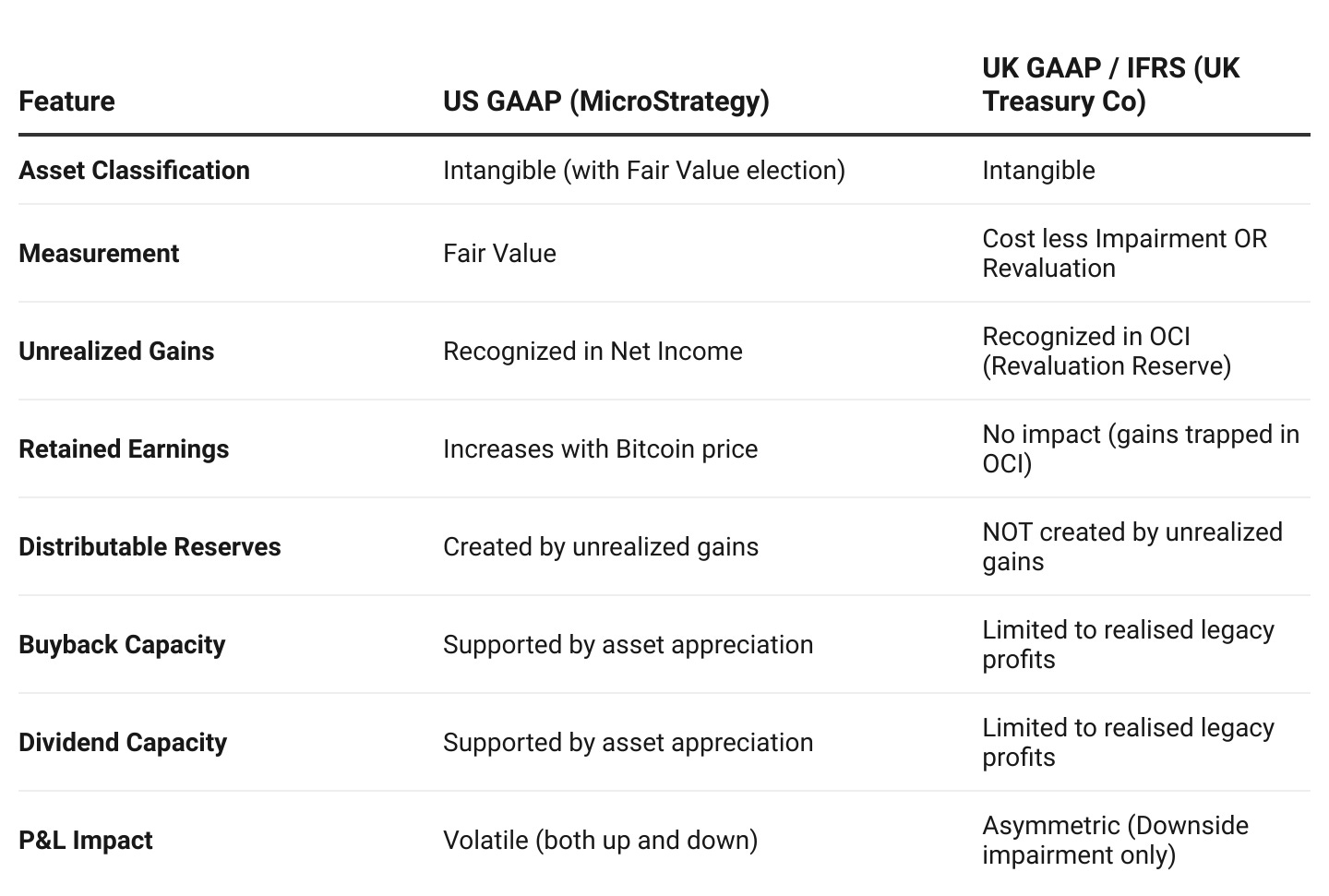
This table demonstrates why the “flywheel” cannot spin in London.
The UK model is an engine without fuel, reliant entirely on the narrative of “future adoption” while legally incapacitated from delivering current returns.
Addendum
The “IQ Test” Defence Mechanism
The systemic risk identified in Section 5 manifested again in real-time.
When pressed on the mechanics of the UK model, the advisory response has shifted from technical compliance to personal attack. As seen in the screenshot below from this morning, the defence against forensic scrutiny is now to label valid questions about capital maintenance as “hate” and to claim that understanding solvency rules is an “IQ test” that traditional finance professionals are failing.

This confirms the report’s conclusion: The narrative has superseded the arithmetic.
When an advisor dismisses the Companies Act 2006 as a conspiracy of “TradFi bros”, it is a red flag that the strategy relies on ideology, not legality.
The Reality: The inability of a UK company to legally distribute unrealized Bitcoin gains isn’t an “IQ test” - it is a Solvency Test. And right now, the model being sold to UK directors fails it.
Works cited
screencapture-linkedin-feed-update-urn-li-activity-7404425898508316672-2025-12-11-22_45_00 (1).pdf
Accounting for cryptocurrencies under FRS 102 - ICAEW, accessed on December 12, 2025, https://www.icaew.com/technical/tas-helpsheets/financial-reporting/cryptocurrencies-under-frs-102
Smarter Web Company - Interim Financial Statements to 30 April 2025 - Aquis Exchange, accessed on December 12, 2025, https://www.aquis.eu/stock-exchange/announcements/5289825
A PROPOSAL TO ALLEVIATE PROBLEMS WITH DISTRIBUTABLE PROFITS THROUGH AMENDMENTS TO THE FOURTH COMPANY LAW DIRECTIVE Introduction - ICAEW, accessed on December 12, 2025, https://www.icaew.com/-/media/corporate/files/technical/ethics/interim-proposal-fourth-company-law-directive-papers-icaew.ashx
Companies Act 2006 - Legislation.gov.uk, accessed on December 12, 2025, https://www.legislation.gov.uk/ukpga/2006/46/section/830/enacted?view=plain
Companies Act 2006 (c. 46) - Legislation.gov.uk, accessed on December 12, 2025, https://www.legislation.gov.uk/ukpga/2006/46/part/23/enacted/data.xht?view=snippet&wrap=true
INTRODUCTION TO THE LAW ON DIVIDENDS - ICAEW, accessed on December 12, 2025, https://www.icaew.com/-/media/corporate/files/technical/ethics/company-law/introduction-to-the-law-on-dividends.ashx
ICAEW and ICAS publish revised guidance on determination of distributable profits, accessed on December 12, 2025, https://shepwedd.com/knowledge/icaew-and-icas-publish-revised-guidance-determination-distributable-profits/
Explanatory Note - The Financial Services and Markets Act 2000 (Regulated Activities) Order 2001, accessed on December 12, 2025, https://www.legislation.gov.uk/uksi/2001/544/note
2025 No. 000 FINANCIAL SERVICES The Financial ... - GOV.UK, accessed on December 12, 2025, https://assets.publishing.service.gov.uk/media/680f6387faff81833fcae94b/0302425_draft_RAO_SI.pdf
The Financial Services and Markets Act 2000 (Regulated Activities etc.) (Amendment) Order 2025 - Legislation.gov.uk, accessed on December 12, 2025, https://www.legislation.gov.uk/ukdsi/2025/9780348272055
Head Of Bitcoin Strategy Appointment | Company Announcement - Investegate, accessed on December 12, 2025, https://www.investegate.co.uk/announcement/rns/the-smarter-web-company-plc--swc/head-of-bitcoin-strategy-appointment/9066727
Smarter Web Company - Appointment of Bitcoin Strategy Consultant - Aquis Exchange, accessed on December 12, 2025, https://www.aquis.eu/stock-exchange/announcements/5229615
The UK regime for cryptoassets: draft rules and legislation - Norton Rose Fulbright, accessed on December 12, 2025, https://www.nortonrosefulbright.com/en/knowledge/publications/8d8b8337/the-uk-regime-for-cryptoassets-draft-rules-and-legislation
Saxon Woods v Costa: a cautionary tale for directors - Fieldfisher, accessed on December 12, 2025, https://www.fieldfisher.com/en/insights/saxon-woods-v-costa-a-cautionary-tale-for-director
“They will thank me in the long run” - unfair prejudice lessons learned from Saxon Woods v Costa, accessed on December 12, 2025, https://www.lewissilkin.com/insights/2025/07/15/they-will-thank-me-in-the-long-run-unfair-prejudice-lessons-learned-from-saxo-102kt57
Smarter Web Company acquires 325 more bitcoin for £27.1 million - Investing.com, accessed on December 12, 2025, https://www.investing.com/news/company-news/smarter-web-company-acquires-325-more-bitcoin-for-271-million-93CH-4136877
Nakamoto Holdings Stock Plummets: Bitcoin Treasury Firm Faces Challenges After Steep Dec - Markets.com, accessed on December 12, 2025, https://www.markets.com/news/nakamoto-holdings-stock-collapse-bitcoin-treasury-1459-en
Bitcoin treasury narrative gets ‘annihilated’ for firm as stocks collapse over 96% - DL News, accessed on December 12, 2025, https://www.dlnews.com/articles/markets/nakamoto-nosedives-in-blow-for-bitcoin-treasury-narrative/
B HODL PLC - Company Update & Appointment of Joint Broker - Aquis Exchange, accessed on December 12, 2025, https://www.aquis.eu/stock-exchange/announcements/5414840
Brand Communications, accessed on December 12, 2025,
https://www.branduk.net/